
Affiliate Marketing Compliance: What You Need to Know
Affiliate marketing doesn’t fail because of bad traffic or weak offers.
It fails when compliance gets ignored.
In today’s landscape, platforms tighten policies faster than ever, algorithms evolve constantly, regulators increase enforcement, and users are far more privacy-aware than they used to be. Compliance is no longer a “legal checkbox.” It’s a performance lever.
Get it right, and your campaigns scale cleanly, accounts stay alive, and revenue compounds over time. Get it wrong, and even the best-performing campaigns can disappear overnight.
This guide breaks down what партнёрский маркетинг compliance really means, which rules actually matter in 2026 and beyond, and how top-performing affiliates and advertisers stay compliant without slowing growth.
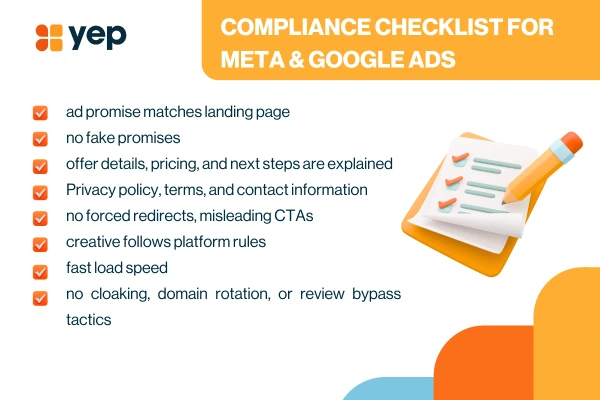
Quick Compliance Checklist for Meta & Google Ads
Before you push any campaign live on Meta or Google, pause for 60 seconds and run through this list. It’ll save you weeks of headaches later.
- Your ad promise matches your landing page exactly
- No guaranteed results, income claims, or exaggerated outcomes
- Offer details, pricing, and next steps are clearly explained
- Privacy policy, terms, and contact information are visible
- No forced redirects, fake buttons, or misleading CTAs
- Creative and copy follow platform rules for your vertical
- Landing page loads fast and works on mobile
- No cloaking, domain rotation, or review bypass tactics
If every box is checked, you’re already ahead of most suspended accounts.
What Is Affiliate Marketing Compliance?
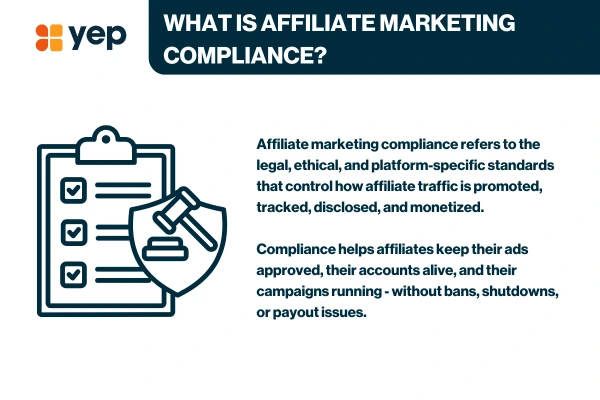
Affiliate marketing compliance refers to the legal, ethical, and platform-specific standards that control how affiliate traffic is promoted, tracked, disclosed, and monetized. Compliance helps affiliates keep their ads approved, their accounts alive, and their campaigns running – without bans, shutdowns, or payout issues.
It covers how offers are advertised, how user data is collected, how partnerships are disclosed, and how источники трафика comply with regulations, ad platform policies, and network rules.
In simple terms:
Compliance ensures your traffic is transparent, lawful, brand-safe, and sustainable – while still converting.
When compliance is built into your strategy, campaigns scale faster and survive longer.
Why Compliance Matters More Than Ever
Affiliate marketing has matured. Platforms and regulators actively monitor traffic quality, disclosures, and data usage.
Non-compliance no longer leads to warnings – it leads to:
- Account suspensions or permanent bans
- Frozen affiliate payouts
- Advertiser clawbacks
- Blocked payment processors
- Lost traffic sources
On the flip side, compliant campaigns see:
- Higher advertiser trust
- Longer-running offers
- Better platform approvals
- More predictable scaling
Compliance is no longer about avoiding penalties – it’s about protecting ROAS.
Why Meta Ads Might Suspend an Account
Meta (Facebook and Instagram) usually suspends accounts when ads create risk for users or the platform – not just because of one bad ad, but because of repeated signals.
The most common reason is misleading messaging. This includes exaggerated results, income claims, “guaranteed” outcomes, or before-and-after promises that feel unrealistic. Even high-converting ads can get flagged if they overpromise.
Another frequent trigger is landing page inconsistency. If your ad says one thing but the page delivers something different – hidden terms, forced redirects, unclear pricing, or sudden offer changes – Meta treats that as deception.
Accounts are also suspended due to poor user experience signals, such as high ad hides, negative feedback, low engagement, or users reporting ads. Meta’s algorithm watches how people react, not just what you say.
Finally, policy evasion is a fast track to suspension. Cloaking, rotating domains, using fake profiles, or trying to bypass ad reviews almost always leads to permanent bans.
In short: Meta suspends accounts when ads mislead users, land on low-trust pages, or repeatedly generate negative user signals.
Why Google Ads Might Suspend an Account
Реклама Google is even stricter, especially when it comes to transparency and intent.
A top reason for suspension is unacceptable business practices. This includes unclear billing, hidden subscriptions, misleading funnels, fake urgency, or not clearly explaining what happens after the click.
Google also aggressively enforces rules against circumventing systems. Cloaking, showing different content to reviewers, redirect tricks, or repeatedly opening new accounts after a suspension usually result in immediate account shutdowns.
Landing page quality issues are another major factor. Slow pages, broken links, malware warnings, auto-downloads, or missing privacy and data-use disclosures all put accounts at risk.
Affiliate marketers often get flagged for thin or low-value pages — pages created only to push users to another offer without real information, clarity, or added value.
In simple terms: Google suspends accounts when ads or landing pages confuse users, hide important details, or try to manipulate the system.
Core Affiliate Compliance Areas You Must Follow
1. Disclosure & Transparency
Affiliates must clearly disclose relationships when promoting offers. Users should never feel misled about whether content is sponsored, incentivized, or promotional.
Clear disclosures build trust – and reduce refunds, chargebacks, and complaints.
2. Privacy & Data Protection
If you collect or process user data, you must comply with privacy regulations such as:
This includes proper consent, cookie notices, opt-outs, and secure data handling.
Privacy violations are one of the fastest ways to lose advertiser relationships.
3. Platform Policy Compliance
Every major traffic source has its own affiliate rules.
- Реклама Google: strict policies around cloaking, misleading claims, and landing page transparency
- Meta (Facebook/Instagram): disclosure clarity, accurate claims, compliant creatives
- Email platforms: unsubscribe functionality, sender identification, consent-based lists
Ignoring platform-specific rules is one of the most common causes of campaign shutdowns.
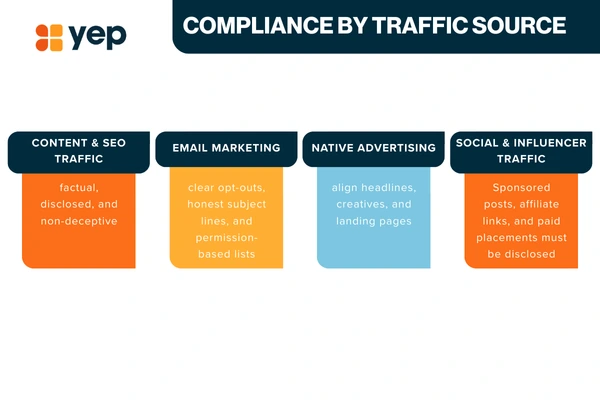
Compliance by Traffic Source (Where Most Mistakes Happen)
Content & SEO Traffic
Content must be factual, disclosed, and non-deceptive. Fake reviews, misleading comparisons, or overpromising claims are common violations. Transparency actually helps rankings.
Поисковый трафик rewards transparency and depth – compliance helps rankings.
Email Marketing
Email traffic must follow CAN-SPAM and local regulations. This means clear opt-outs, honest subject lines, and permission-based lists.
Non-compliant email campaigns are often blocked before they even convert.
Нативная реклама
Нативная реклама must align headlines, creatives, and landing pages. Mismatch between promise and reality is a major red flag for networks and advertisers.
Clean funnels convert better – and survive longer.
Social & Influencer Traffic
Sponsored posts, affiliate links, and paid placements must be disclosed clearly. Platforms increasingly detect hidden promotions automatically.
Short-term tricks now lead to long-term bans.
What Actually Happens When Compliance Is Ignored
Non-compliance rarely fails slowly. It fails instantly. Campaigns get paused mid-scale. Accounts lose access without appeal. Payouts get held while traffic is reviewed. Advertisers pull offers – even if conversions were strong.
Strong performance doesn’t protect bad compliance.
Good compliance protects strong performance.
How Top Affiliates Stay Compliant (Without Killing Speed)
High-performing teams don’t “wing” compliance – they systemize it.
They:
- Review offers and landing pages before launch
- Maintain internal compliance checklists
- Monitor creatives during scaling
- Rotate compliant messaging instead of pushing limits
- Work with networks that actively review traffic quality
Compliance becomes part of optimization, not an obstacle to it.
Compliance From the Advertiser’s Side
Advertisers are responsible too.
They must:
- Approve affiliates properly
- Define allowed traffic sources clearly
- Monitor claims, creatives, and funnels
- Enforce compliance consistently
The best advertiser–affiliate relationships are built on clarity, not guesswork.
Why Compliance Is a Competitive Advantage
In crowded verticals, compliant affiliates win more than just approvals – they win trust.
Advertisers prioritize them. Platforms approve them faster. Networks scale them longer.
Compliance doesn’t slow growth.
It protects it.
Affiliate Marketing Compliance at Yep Ads
At Yep Ads, compliance is built into performance – not layered on after. In terms of compliance and quality control, we follow strict internal standards to ensure traffic integrity and advertiser safety. We work exclusively with trusted and validated traffic sources and use a private approval process before launching any new campaigns or placements. Our team continuously monitors traffic quality and performance, applies fraud prevention measures, and filters any invalid or non-compliant traffic. We strictly follow advertiser guidelines, brand requirements, and compliance policies to ensure full transparency and long-term partnership stability. We are also open to implementing additional partner-specific compliance procedures and quality control measures when required.
We actively:
- Review traffic sources and funnels
- Support transparent, brand-safe promotion
- Work closely with advertisers on policy alignment
- Help affiliates scale without risking shutdowns
Because sustainable performance always beats short-term volume.
Заключительные размышления
Affiliate marketing compliance isn’t about fear or restriction – it’s about control.
Control over traffic quality.
Control over scale.
Control over longevity.
The affiliates and advertisers who win long-term are the ones who treat compliance as part of strategy, not paperwork.
If you want to grow faster, get paid consistently, and keep campaigns alive – compliance isn’t optional anymore.
Вам также может понравиться
- What Is Affiliate Marketing? A 2026 Full Guide
- Affiliate Agencies vs. Going Direct: Which Is Better in 2026?
- Performance-стратегии: 9 проверенных тактик для максимизации ROI
- Who Can Become an Affiliate & How to Get Started in 2026
- How to Start an Affiliate Program: A Step-by-Step Guide for Brands and Small Businesses
Affiliate Marketing Compliance: FAQs
1. What does compliance actually mean for affiliate marketers?
For affiliates, compliance means promoting offers in a way that’s transparent, truthful, and aligned with platform, legal, and network rules. So ads get approved, accounts stay active, and traffic converts without risking bans or withheld payouts.
2. Is affiliate marketing compliance really necessary if my campaigns are profitable?
Yes. Strong performance doesn’t protect non-compliant campaigns. Even highly profitable ads can be paused, accounts suspended, or payouts frozen if policies are violated. Compliance protects your revenue and allows campaigns to scale long-term.
3. What are the most common compliance mistakes affiliates make?
The biggest mistakes include exaggerated claims, mismatched ad copy and landing pages, missing disclosures, collecting user data without consent, and trying to bypass platform reviews through cloaking or redirects. These issues trigger most Meta and Google suspensions.
4. Does being compliant reduce conversion rates?
No, in many cases, it improves them. Clear messaging, honest claims, fast-loading pages, and transparent funnels build trust, reduce refunds, and improve post-click behaviour, which platforms now reward with better delivery.
5. How can beginners stay compliant without slowing down?
Start with a simple checklist before every launch: match ad and landing page messaging, disclose affiliations, include privacy policies, follow platform rules, and test creatives that focus on value instead of hype. Compliance becomes easy once it’s part of your workflow.
Поделиться