
LinkedIn Algorithm Changes 2026: Why LinkedIn Reach is Dropping
If your LinkedIn impressions have taken a nosedive recently, you’re not imagining things.
LinkedIn has rolled out its biggest algorithm overhaul in history, a 150-billion-parameter AI model called 360Brew. First introduced in a research paper in January 2025 and gradually deployed throughout the year, it’s completely reshaping how content gets distributed on the platform.
But here’s one of the biggest announcements with LinkedIn’s new algorithm change: LinkedIn’s AI is now smart enough to detect AI-generated content. And it’s not rewarding it.
If your social strategy has been leaning on ChatGPT or other AI tools to crank out LinkedIn posts, you’ve probably noticed the drop already. Posts that once pulled thousands of impressions are now sitting at a few hundred. It’s not a glitch, it’s the new normal.
The good news? This isn’t a death sentence for your LinkedIn presence. It’s actually a massive opportunity if you know how to adapt. Let’s break down what’s happening, why it matters, and our idea on what you can do about it.
Вам также может понравиться:
- Meta’s Andromeda Update: Facebook Algorithm Change
- Facebook Algorithm Changes 2026: An Affiliate’s Guide
- LinkedIn’s 360Brew algorithm evaluates your content, profile, and engagement patterns together as a whole not in isolation making a consistent, cohesive presence more important than ever.
- AI-generated and template-style content is actively being deprioritized 360Brew is designed to detect generic posts and reduce their distribution.
- Organic reach has dropped roughly 50% year-over-year, but creators posting authentic, expert-level content are actually seeing stronger results than before.
- Thought leadership is the new growth strategy the algorithm rewards depth, expertise, and topic consistency over posting volume and engagement hacks.
- In-post interactions are critical signals saves, comments, and reposts carry the most weight in telling 360Brew whether your content deserves wider distribution.
- Your profile must match what you post about if your headline and experience don’t align with your content topics, 360Brew will suppress your reach.
Оглавление
- What Is LinkedIn’s 360Brew Algorithm?
- Why AI-Generated Content Is Losing Reach
- How 360Brew Detects AI and Low-Quality Content
- The Numbers: What’s Actually Happening in 2026
- How to Fix Your LinkedIn Strategy
- Thought Leadership: The New LinkedIn Playbook
- Quick Wins You Can Implement This Week
- Заключительные размышления
- Вопросы и ответы
What Is LinkedIn’s 360Brew Algorithm?
Let’s start with what actually changed.
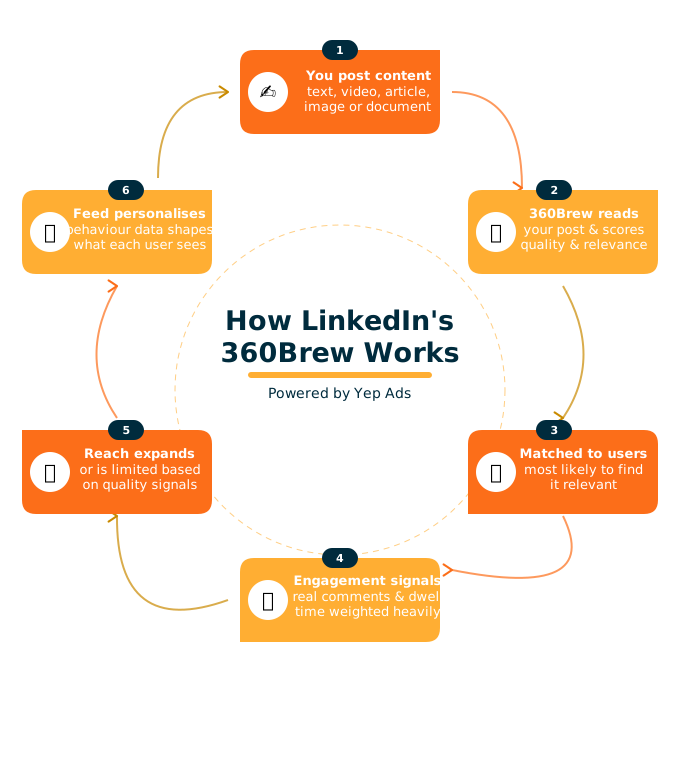
360Brew is LinkedIn’s new foundation AI model, developed by their FAIT (Foundation AI Technologies) team and published as a research paper on arXiv. It replaces the old system, which LinkedIn experts have described as a “feature factory” of separate, disconnected ranking models with a single, unified AI that evaluates everything together.
Think of it this way: the old algorithm was like a factory assembly line, checking individual boxes (likes, comments, shares). 360Brew is more like a human editor, reading and understanding everything holistically.
Источник: Мы
Here’s what makes it fundamentally different:
It Reads Your Content Semantically
The old algorithm relied on keywords and hashtags to figure out what your post was about. 360Brew actually understands the meaning behind your words. As Melonie Dodaro explains, the system now evaluates “what’s being said and who it’s most relevant for” not just whether it contains trending keywords.
Hashtags? SMM experts are noticing that they no longer play a role in distribution. LinkedIn analyzes the recurring themes in your content to understand what you consistently talk about and who finds it relevant.
It Evaluates Your Profile and Content as One Package
This is the shift that caught most people off guard. 360Brew performs what industry experts call a “profile content audition.” It cross-references what you post against your headline, About section, and work experience.
If your profile says “Marketing Director” but you’re posting about cryptocurrency, the algorithm sees a mismatch and suppresses distribution. But when a RevOps Director writes about Salesforce integration? The system assigns higher confidence and unlocks broader reach.
It Measures Depth, Not Just Clicks
The new system prioritizes what’s being called a “Dwell time” how long people actually spend reading your content, the quality of comments it generates, and whether people save it for later. Forbes contributor Jodie Cook reported after visiting LinkedIn’s NYC headquarters that saves have become one of the most critical ranking signals a post with 200 saves now dramatically outperforms one with 1,000 likes.
It Builds Your Topic Authority Over Time
Post consistently about 2–3 related topics for 60–90 days, and 360Brew starts to recognize you as a credible voice in that space. Scatter your posts across random topics, and the algorithm can’t figure out who should see your content. As The Linked Blog noted, “authority will be built through repetition and coherence.”
In short: LinkedIn went from rewarding people who game the system to rewarding people who actually know what they’re talking about.
Why AI-Generated Content Is Losing Reach
This is the question everyone’s asking and the reason a lot of brands and creators are seeing their numbers tank.
360Brew has been built to detect and deprioritize low-quality, generic content. And unfortunately, a lot of AI-generated posts fall squarely into that category. It’s not that LinkedIn has explicitly banned AI content. It’s that the algorithm is designed to reward authenticity, unique perspective, and human voice things that most unedited AI output lacks, the same authenticity gap that’s driving the shift toward UGC-style content across other platforms too.
Here’s what’s happening under the hood:
Pattern recognition at scale. 360Brew can identify content that follows common AI templates, the predictable structures, the overly polished grammar with zero personality, the lack of personal anecdotes or specific examples. When your post reads like every other ChatGPT output on the platform, the algorithm treats it as low-value noise. Melonie Dodaro highlights that the system “detects repetition, templated phrasing and engagement bait, and it reduces visibility when content feels forced or off-topic.”
Engagement signals tell the real story. AI-generated posts tend to generate surface-level engagement quick likes, generic one-word comments. 360Brew is specifically looking for the opposite: dwell time (how long someone spends reading), saves (bookmarks), and substantive comments that add to the conversation. Generic AI content rarely sparks that kind of interaction.
The “post and ghost” penalty. Many people using AI to write their LinkedIn posts also aren’t sticking around to engage after publishing. They post and disappear. 360Brew notices this pattern and interprets it as low commitment, which reduces distribution further.
The expertise gap. AI tools can write about almost anything, but they can’t demonstrate real expertise. 360Brew is looking for signals that you’ve actually done the work specific results, real-world examples, industry specific language that comes from experience. AI content tends to stay general and surface-level, which the system reads as low-authority.
The bottom line: if your LinkedIn content could have been written by anyone (or any AI), the algorithm treats it like it was written by no one in particular and distributes it to no one in particular.
How 360Brew Detects AI and Low Quality Content
You might be wondering: Can the algorithm really tell the difference between human and AI-written posts?
The honest answer is that 360Brew doesn’t rely on a simple binary “AI detector.” What it does is evaluate a combination of signals that, together, make low-effort AI content pretty easy to spot:
Lexical diversity. Human writers naturally vary their vocabulary, sentence structure, and rhythm. AI tends to fall into patterns repeating similar phrases, using predictable transitions, and maintaining an unnaturally consistent tone. 360Brew’s semantic engine picks up on this. Research from Pettauer.net notes that Dodaro’s work specifically highlights how the system uses lexical diversity to separate authentic content from what she calls “slop” low-quality, generic AI-generated text.
Profile-content alignment. As we mentioned, the algorithm checks whether your posts match your stated expertise. AI written content often lacks the specific, contextual language that comes from real professional experience. A real affiliate marketing professional talking about campaign optimization will naturally use terminology and reference situations that a generic AI post about “marketing tips” simply won’t.
Engagement quality correlation. If your posts consistently generate low-effort comments (“Love this!” “So true!” “Agree!”), The algorithm infers your content isn’t sparking real conversation. 360Brew specifically looks for what it considers “low entropy noise” in comment sections where ten comments share similar phrasing. AI-generated posts are particularly prone to attracting this hollow engagement.
Behavioral pattern analysis. 360Brew tracks your full activity posting frequency, timing, and engagement habits. If you’re publishing perfectly polished posts daily but never commenting on anyone else’s content or engaging in conversations, that signals automation over authenticity.
Here’s the important nuance: this doesn’t mean you can never use AI tools. It means you can’t rely on them to do the thinking for you. AI as a brainstorming partner or editing assistant? Fine. AI as a ghostwriter publishing unedited content? That’s what’s getting caught.
The Numbers: What’s Actually Happening in 2026
Let’s talk data. The numbers are eye opening, but understanding them is the first step to turning things around.
Согласно Richard van der Blom’s Algorithm Insights report, which analyzed over 1.8 million LinkedIn posts, and AuthoredUp’s dataset of 3+ million posts:
Did you know?

Organic reach has dropped roughly 50% year-over-year since 360Brew launched. |

Company page reach has fallen 60–66% — personal profiles now get dramatically more distribution. |

Document carousels drive 2–3× more dwell time than text or image posts alone. |

A post with 200 saves now dramatically outperforms one with 1,000 likes in the 360Brew ranking. |

Post consistently on 2–3 topics for 60–90 days and 360Brew starts recognising you as a credible voice in your niche. |

Posts with external links in the caption see roughly 60% less reach — and hashtags no longer drive distribution at all. |
Источник изображения: Мы
Those numbers are tough. But here’s the flip side and this is the part worth paying attention to:
Creators who adapted are doing better than ever. The same data shows that niche, expert-level content is getting amplified more than before. If you’re consistently posting valuable, authentic content in a specific topic area, 360Brew actually rewards you with better distribution to a more targeted, relevant audience.
Our take: LinkedIn is now more selective. The platform is rewarding brands and professionals who show up with real expertise and genuine perspective, and filtering out the rest. For performance marketers, that’s actually a good thing. It means less noise competing for the same audience, and a bigger advantage for brands that invest in authentic content.
“Honestly, this update hit our own LinkedIn presence before we fully understood what was driving it. Watching reach drop on content we’d put real effort into was frustrating enough that we went deep on the research and what we found changed how we approach the platform entirely. That’s why we’re sharing this.”
How to Fix Your LinkedIn Strategy
Now the good news: this is fixable. Here’s how to adapt your LinkedIn strategy to work with 360Brew, not against it.
1. Define Your Content Pillars (and Commit to Them)
360Brew rewards topic consistency. Pick 2–3 core topics that align with your expertise and your business goals, and commit to posting about them for at least 90 days.
For example, if you’re in performance marketing, your pillars might be: affiliate strategy and best practices, compliance and brand safety, and emerging channels like LLM advertising. Every post should connect back to one of these pillars. Creators building a content pillar around partnerships specifically will find a lot to draw from in influencer content strategy, since the same authenticity-over-polish principles apply.
Why 90 days? That’s roughly how long it takes for 360Brew to categorize your profile’s expertise and start optimizing your distribution within those topic areas.
2. Write Like a Human (Because That’s Literally the Point)
This doesn’t mean you need to be a professional writer. It means:
Share personal experiences and specific examples. “Last quarter, we tested a new affiliate onboarding approach and here’s what happened…” beats “Here are 5 tips for affiliate onboarding” every single time. The algorithm and your audience both respond to specificity.
Have an opinion. The algorithm rewards “knowledge and advice” not neutral summaries of what everyone already knows. Take a stance. Share a lesson learned. Respectfully disagree with conventional wisdom. This is what makes content feel like it came from a real person.
Ditch the AI template voice. If your post sounds like it could have been written by anyone, rewrite it until it sounds like it could only have been written by you. Add your industry context, your real results, your honest take.
Keep it conversational. Write the way you’d explain something to a smart colleague over coffee. Clear, direct, with personality. This is exactly the kind of voice that 360Brew is built to reward.
3. Optimize Your Profile for Content Alignment
Remember the profile content audition? Your headline, About section, and experience need to match the topics you’re posting about. If there’s a disconnect, 360Brew reduces your content’s reach.
Take 30 minutes to update your profile so it clearly reflects your 2–3 content pillars. Make sure your headline isn’t just a job title it should signal what you’re an expert in. For instance, “Performance Marketing Director | Scaling Brands Through Affiliate & Paid Media” tells the algorithm far more than “Director at Company X.”
4. Prioritize Meaningful Engagement Over Metrics
Under the new algorithm, how you engage matters just as much as what you post:
Comment thoughtfully on posts in your niche. Not “Great post!” add a perspective, ask a follow up question, share a related experience. Think 3+ sentences minimum. This signals to the algorithm that you’re an active, valuable member of your topic community.
Respond to every comment on your own posts within the first hour. Early engagement velocity still matters, but now it’s the quality of that engagement that determines whether your post gets wider distribution.
Aim for 15–30 meaningful comments per day across your network. This builds what experts call “network gravity” the more you engage authentically in your topic area, the more the algorithm associates you with that space and shows your content to the right people.
5. Focus on the Metrics That Actually Matter
Likes don’t carry much weight anymore. Hashtags are essentially irrelevant. Engagement pods are actively detected and penalized reports indicate LinkedIn’s AI can identify reciprocal engagement patterns and apply reach suppression.
The metrics to track now: dwell time (are people reading your full post?), saves (are people bookmarking it?), and comment quality (are people adding to the conversation?). These are the signals 360Brew uses to decide whether your content deserves wider distribution.
6. Post Less, but Better
Here’s a counterintuitive one: posting too often can actually hurt you. When you publish daily, each new post “cannibalizes” the reach of the previous one before it’s had time to fully circulate.
A high-performing post now has an extended lifespan of 48–72 hours under 360Brew. The sweet spot for most creators is 3–4 posts per week, focusing on making each one genuinely valuable rather than filling a content calendar for consistency’s sake.
Thought Leadership: The New LinkedIn Playbook
If there’s one takeaway from the 360Brew shift, it’s this: thought leadership isn’t optional anymore it’s the algorithm’s primary reward signal.
Here’s what thought leadership actually looks like under the new algorithm:
Lead with insight, not observation. Don’t just describe what’s happening in your industry, explain why it matters, what it means for your audience, and what they should do about it. The algorithm and your audience can both tell the difference between “sharing a trend” and “providing expert analysis.”
Create “saveable” content. Posts that people bookmark are incredibly valuable under 360Brew. Think frameworks, step-by-step breakdowns, contrarian takes backed by experience, and practical checklists people want to reference later. The save signal tells LinkedIn your content has lasting utility.
Use the text + image format strategically. Data-heavy text paired with a relevant visual (a chart, a screenshot, a framework) tends to perform well because it satisfies both the AI’s need for semantic text and the human need for visual engagement. Document carousels (PDF uploads) are also driving strong results roughly 2–3x more dwell time than text or image posts alone.
Activate your team’s personal profiles. Company pages have seen the biggest reach decline under 360Brew. Personal profiles now get dramatically more distribution than brand pages. If you’re running social for a company or agency, the biggest lever is getting your leadership team to post from their personal profiles with their own authentic voice.
This is especially relevant for agencies. Your team members are your best distribution channel. A founder sharing a genuine lesson learned will outperform a polished company page graphic every time.
Play the long game. Как The Linked Blog notes, “great ideas gain traction over time, not just in the first hour.” Under 360Brew, posts can resurface days or even weeks later if they continue to drive meaningful engagement. This rewards content that ages well not posts designed for a 24-hour shelf life.
Quick Wins You Can Implement This Week
Not sure where to start? Here’s a practical checklist:
Today:
- Audit your last 10 LinkedIn posts. How many were AI-generated or heavily templated? That’s your baseline.
- Update your LinkedIn headline and About section to clearly reflect your core expertise areas.
This week:
- Write one post from personal experience a specific challenge, result, or lesson learned from your actual work. No templates. No unedited AI drafts.
- Leave 5 thoughtful comments (3+ sentences each) on posts from people in your industry niche.
- Remove any engagement bait phrases from your posting habits (“Comment YES if you agree” is actively penalized now).
This month:
- Establish your 2–3 content pillars and commit to 3–4 posts per week around those topics.
- Start tracking saves and comment quality instead of likes and impressions.
- If you manage a company page, begin activating personal profiles from team leadership as your primary distribution channel.
- Experiment with document carousel posts (PDF format), they’re currently the highest-engagement format on the platform.
Заключительные размышления
LinkedIn’s 360Brew algorithm isn’t punishing you it’s pushing everyone toward better content.
Yes, the shift away from AI-generated content and engagement hacks is uncomfortable, especially if your content strategy was built around those shortcuts. But the brands and creators who are adapting to this new reality are already seeing results that the old system could never deliver: better-targeted reach, higher-quality engagement, and real professional relationships instead of vanity metrics.
The formula is straightforward: be a real person, share real expertise, and engage with your community like you actually care. That’s always been the right approach LinkedIn’s algorithm has just finally caught up.
At Yep Ads, we help brands build smarter growth strategies across every channel including the ones that are changing fast. Whether it’s scaling through affiliate partnerships, building brand awareness that actually compounds, or adapting your social presence to new platform realities, we’ve got your back. Let’s talk.
Вопросы и ответы
Is LinkedIn really banning AI-generated content?
Not exactly. LinkedIn hasn’t officially banned AI content, and there’s no “AI detector” that automatically blocks posts. What’s happening is more nuanced: the 360Brew algorithm rewards authenticity, depth, and personal expertise. AI-generated content that lacks these qualities naturally gets less distribution. You can still use AI for brainstorming or editing, the final product just needs to sound like you and reflect genuine experience.
How long does it take to recover LinkedIn reach after the algorithm change?
Most experts suggest that consistent, quality posting around focused topic pillars starts showing results within 2–4 weeks. Building real topic authority with the algorithm takes closer to 60–90 days of consistent effort. The key is patience and quality 360Brew needs time to learn what you’re about and start associating your profile with your niche.
Do hashtags still matter on LinkedIn in 2026?
Not really. Since 360Brew uses semantic understanding to categorize content, it doesn’t rely on hashtags for distribution. Some practitioners still use 3–5 niche hashtags for minor discoverability, but they’re no longer a meaningful growth lever. Overusing hashtags can actually trigger spam detection.
Should brands post from company pages or personal profiles?
Personal profiles, without question. Company page reach has dropped 60–66% under 360Brew, while personal profiles get significantly more distribution. The most effective strategy is employee advocacy having your team’s leadership post from their personal profiles with their own authentic voice, while the company page serves as a supporting hub rather than the main channel.
What content formats perform best under the new algorithm?
Document carousels (PDF uploads) are currently the strongest format, driving roughly 2–3x more dwell time than text or image posts. Text posts with relevant images also perform well. Video under 30 seconds works for awareness-stage content. Posts with external links in the main caption see roughly 60% less reach, so consider alternative approaches like directing people to your profile’s featured section.
Вам также может понравиться
- Brand Building vs. Short-Term Performance: Why the Smartest Brands Do Both
- Meta’s Andromeda Update: Facebook Algorithm Change
- What Is Brand Awareness? Why It Matters and How to Grow It
- LLM Advertising Wave: New Acquisition Channel
- Affiliate Marketing Compliance: What You Need to Know
- What Is Influencer Content Strategy?
Поделиться