
Buy on LLMs & Agentic eCommerce: What It Means for Brands
AI is changing how people discover and decide what to buy but not in the dramatic, overnight way many headlines suggest.
Terms like “Buy on LLMs” and “Agentic eCommerce” are everywhere right now. Some interpret them as the end of search, the end of affiliate marketing, or the end of digital marketing as we know it. In reality, what’s happening is more subtle and much more practical. AI isn’t replacing the buying journey. It’s compressing and reshaping the decision-making part of it.
Understanding that difference is key for brands, affiliates, and anyone working in performance marketing.
Key Takeaways:
- Agentic eCommerce depends on existing web signals, not magic AI knowledge.
- Brands need SEO, content, social media, and reviews to stay visible.
- AI pulls information from websites, publishers, forums, and social platforms. Visibility in AI results is earned through trust and authority. The real advantage is being worth recommending, not paying for placement.
- Search affiliates can’t buy ads inside LLMs today,
- You cannot buy paid ads in ChatGPT right now.
- AI advertising may launch around 2026, likely brand-first and controlled.
What “Buy on LLMs” Actually Means
When people hear “Buy on LLMs,” they often imagine that users complete purchases entirely inside ChatGPT or another AI interface.
That’s not what’s fully happening today yet.
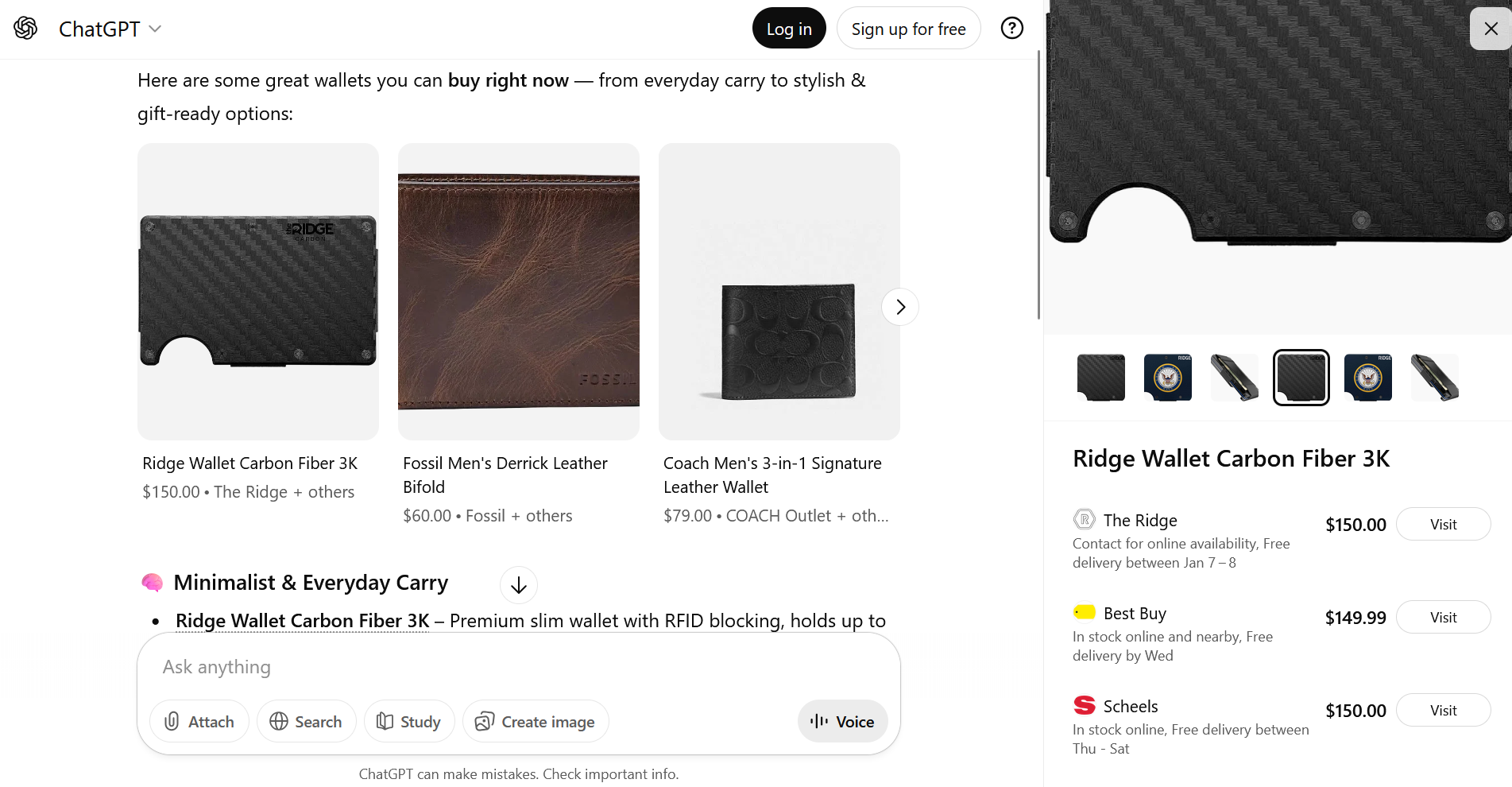
Image Source: Open Ai
What is happening is that users increasingly rely on AI to help them decide. Instead of opening Google, clicking through multiple tabs, reading reviews, and comparing products manually, they ask one question and expect a clear, summarized answer.
The AI explains options, highlights differences, and suggests products or brands. The actual purchase usually still happens on a brand website, marketplace, or app, but by that point, the decision is already mostly made.
ChatGPT Becomes Shoppable: A New Era for Affiliates
Based on the Open AI: “Instant Checkout is available for ChatGPT Pro, Plus and logged-in Free users in the United States. Instant Checkout is currently enabled on eligible items from Etsy, and select Shopify merchants, including Glossier, SKIMS, and Spanx, with more merchants coming soon. If Instant Checkout is not enabled, ChatGPT will still provide you a link out to a merchant’s site to finish checkout.”
For other locations, “Buy on LLMs” doesn’t mean checkout happens inside the chat. It means purchase intent is shaped there. And that makes LLMs a powerful influence layer, not a replacement for e-commerce platforms or search.
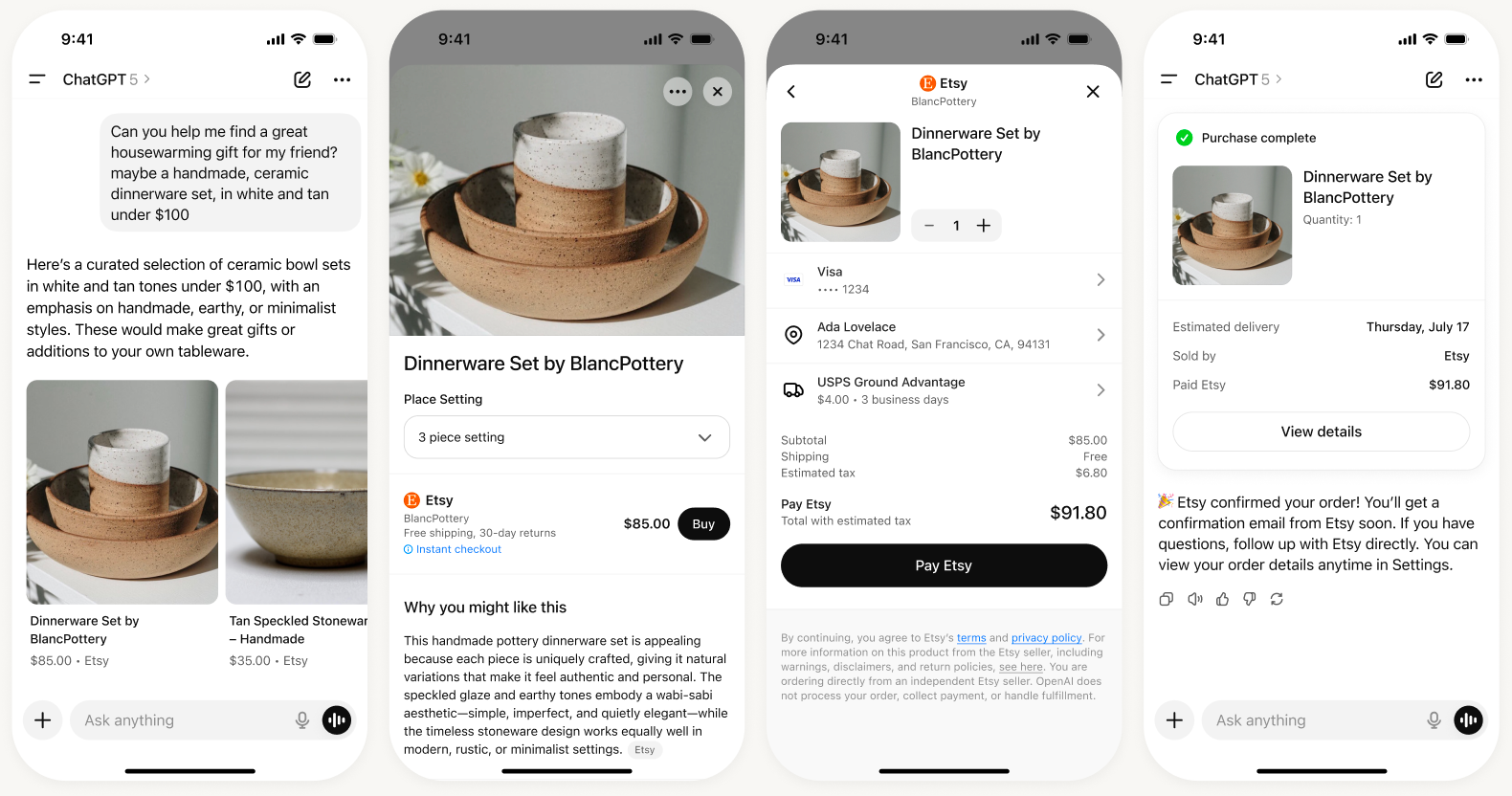
Image Source: Open Ai
Agentic eCommerce: What It Really Is
Agentic eCommerce builds on this idea.
Instead of users actively doing all the work themselves, AI agents can act on their behalf, researching products, comparing prices, checking availability, and eventually initiating purchases or reorders.
This sounds futuristic, but it’s important to ground it in reality.
AI agents don’t invent information. They depend entirely on what already exists across the web: brand websites, product feeds, reviews, social media, Reddit threads, forums, publisher content, and comparison sites.
Agentic commerce doesn’t eliminate marketing. It raises the standard for it.
If a brand isn’t clearly described, consistently visible, and trusted across channels, the agent has nothing reliable to work with.
Why Digital Marketing Still Matters
One of the biggest misconceptions around AI-driven commerce is that SEO, content, social media, and reviews suddenly stop mattering.
In practice, the opposite is true.
LLMs pull signals from everywhere. They learn from structured website content, blog articles, product pages, social discussions, reviews, and community forums. They combine these inputs to decide what sounds credible, relevant, and trustworthy.
That means brands still need to do the fundamentals well: they need strong websites, clear messaging, active social presence, real reviews, and third-party validation.
SEO is no longer just about rankings; it’s about being understood. Social media isn’t just about reach; it’s about credibility signals. Reviews aren’t just for conversion; they shape AI trust.
AI simply connects all of this faster. If your brand has weak visibility or inconsistent messaging, it doesn’t just rank lower it may not be mentioned at all.
Recommendations for Affiliates in an AI-First World
Affiliate marketing isn’t disappearing, but low-effort affiliate content is.
AI doesn’t need another generic “Top 10” list rewritten from product specs. What it values is context: real comparisons, explanations, pros and cons, and clarity around who a product is actually for.
Affiliates who add genuine insight help shape how entire categories are understood. Their content influences not just users, but also how AI summarizes and frames the market.
Search affiliates still play an important role here. Their content feeds the information layer AI pulls from. Even if the final purchase happens elsewhere, affiliate content can influence decisions upstream.
The value shifts from pure last-click attribution to decision influence.
Can Affiliates Buy Paid Ads Inside LLMs?
This is one of the most common questions, especially from search affiliates.
Right now, the answer is no.
You cannot currently buy paid ads directly inside the main ChatGPT interface. There is no keyword bidding, no self-serve ad platform, and no way to pay for guaranteed placement inside AI-generated responses.
LLMs are not designed like search engines. They position themselves as assistants, and user trust is critical. Opening AI answers to unrestricted paid placements would undermine that trust very quickly.
That said, advertising inside LLMs is not off the table forever.
OpenAI has publicly acknowledged that monetization is an active area of exploration, particularly for free users. Industry speculation and leaked internal forecasts suggest that a formal advertising rollout could happen as early as 2026.
When ads do appear, they are unlikely to look like Google Ads. Early models will almost certainly be tightly controlled, brand-led, and focused on maintaining user trust rather than open auctions.
For now, affiliate-style paid traffic simply does not exist inside ChatGPT or similar LLMs.
What This Means for Search Affiliates
Search affiliates are used to competing in auctions. If traffic exists, they can usually buy it.
LLMs break that model.
There’s nothing to outbid inside an AI answer. No keywords to dominate with budget alone. Visibility must be earned through authority, relevance, and presence across the wider web.
Affiliates who rely purely on paid arbitrage will struggle in an AI-driven environment. Affiliates who invest in niche expertise, strong content, and brand recognition are far better positioned.
In AI-assisted discovery, the affiliate who explains the market well has more influence than the affiliate who simply ranks for it.
Could Paid Affiliate Placements Exist in the Future?
Possibly but they won’t be a copy of search ads.
If affiliate monetization appears inside LLMs, it’s more likely to happen through curated partner programs, structured product feeds, or agent-to-agent commerce frameworks where attribution works differently.
This would require new standards for tracking, trust, and contribution, likely involving networks and platforms rather than individual arbitrage setups.
So yes, affiliate monetization inside LLMs may come but it will look very different from traditional paid search.
What Brands Should Take Away From This
The biggest takeaway for brands is simple:
AI doesn’t replace marketing.
It rewards good marketing and ignores weak marketing.
Brands still need SEO, content, social presence, reviews, and partnerships with publishers and affiliates. They still need consistent messaging and clear positioning across channels.
AI simply pulls everything together faster and more aggressively.
If a brand has done the work, AI becomes an amplifier.
If it hasn’t, AI becomes a filter.
Final Thoughts
Buy on LLMs and agentic commerce aren’t about skipping the journey they’re about compressing it.
The brands and affiliates who win won’t be the ones trying to buy their way into AI answers. They’ll be the ones who are genuinely worth recommending.
AI doesn’t change the rules.
It just enforces them faster.
You Might Also Like
- LLM Advertising Wave: New Acquisition Channel
- ChatGPT Ads: How They’ll Work + How Brands Should Prepare (2026)
- How to Get Found on ChatGPT and Google AI
- Brand Building vs. Short-Term Performance: Why the Smartest Brands Do Both
- Marketing Trends & Predictions for 2026
Share