
What Is Multi-Channel Marketing and How It Grows Your Brand
Thinking about expanding into more marketing channels? Even the best-performing campaigns often capture only a fraction of the available audience. Potential customers are spread across different platforms, publishers, and content channels and the brands that show up in multiple places are usually the ones that win the conversion.
Putting all your budget into one channel is also a concentration risk we’ve seen bite too many brands. That’s why we put this together with a breakdown of what multi-channel marketing actually looks like in practice, which channels deserve a spot in your mix, and how adding an affiliate program can open up placements and audiences your current setup simply isn’t reaching.
- Multi-channel marketing means reaching your customers across several platforms. Your existing paid, organic, and owned channels are only part of the picture.
- Brands using three or more channels see dramatically higher purchase rates, engagement, and retention than those relying on one or two.
- An affiliate program is one of the lowest-risk channels to add you only pay when a conversion happens.
- A strong multi-channel strategy doesn’t require reinventing your approach it requires adding the right channels to what’s already working.
Table of Contents
- What Is Multi-Channel Marketing?
- Multi-Channel vs. Omni-Channel: What’s the Difference?
- Why Multi-Channel Marketing Works: The Numbers
- The Core Channels Every Brand Should Know
- Where Affiliate Marketing Fits In
- How to Build a Multi-Channel Strategy That Actually Works
- Common Mistakes to Avoid
- Building Your Multi-Channel Strategy with Yep Ads
- Final Thoughts
- FAQs
1. What Is Multi-Channel Marketing?
Multi-channel marketing is the practice of promoting your brand across multiple platforms simultaneously both digital (social media, search, email, apps, websites) and traditional (TV, print, direct mail) so customers can discover and engage with you wherever they spend time. Rather than waiting for customers to find you on a single platform, multi-channel marketing puts your brand in front of them across the channels they already use, at every stage of their buying journey.
Each channel serves a different purpose: some build awareness, some capture high-intent buyers actively searching for your product, and others re-engage customers who’ve already interacted with your brand. The core idea is that no single channel reaches everyone and the brands showing up in multiple places capture audiences the others miss entirely.
As a brand, you’re probably already running a few of these: paid social, search ads, email, content, display, or influencer partnerships. The goal is simple: reach more of your potential customers while reducing reliance on any single platform. Learn more about why brands are embracing affiliate marketing
Putting all your budget into a single channel is also a risk. Platform costs shift, algorithms change, and what’s working today isn’t guaranteed to work the same way six months from now. Brands that are spread across multiple channels aren’t just reaching more people, they’re also not at the mercy of any single platform’s performance.
Why Brands Are Moving Toward Multi-Channel Acquisition in 2026
According to Omnisend, brands using three or more channels see a 287% higher purchase rate than those on a single channel. That gap exists because different customers live in different places and the brands covering more ground are capturing more of them.
As of 2026, here are the top performing channels by ROI:
- Short-form video is now the highest ROI media format, with 48.6% of marketers ranking it in their top three
- Email averages $36–$44 back for every $1 spent
- SEO delivers the highest long-term ROI of any channel, outperforming both paid and traditional media
What works best still depends on your vertical and audience and that’s something we’ve had to figure out across dozens of brand partnerships. We break it down in Section 4.
2. Multi-Channel vs. Omni-Channel: What’s the Difference?
These get mixed up constantly, so here’s the quick version.
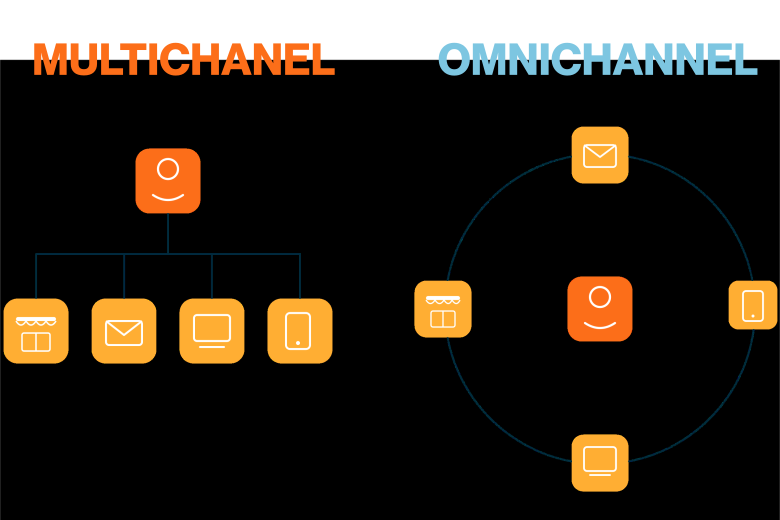
Image Source: Yep Ads
Multi-channel marketing means showing up across multiple platforms with consistent messaging. Each channel operates independently; your paid social, email, and affiliate programs aren’t necessarily talking to each other in real time.
Omni-channel marketing connects those channels so behavior on one platform shapes what a customer experiences on another. Someone browses your product page → your email platform triggers a follow-up → your retargeting ads update to show that exact product. More unified.
For most brands building out their mix especially those adding affiliate multi-channel is the right starting point. Get each channel performing on its own before you try to connect them. That’s the approach we take with new partners, and it makes scaling a lot cleaner.
The good news: adding an affiliate program is one of the simplest ways to extend your multi-channel reach. Your affiliates run independently, the network handles tracking and payouts, and you only pay for what converts.
3. Why Multi-Channel Marketing Works: The Numbers
The numbers speak for themselves.

287% higher purchase rate for brands using 3+ channels vs. one. (Omnisend) |

166% higher engagement with 2+ channels vs. one. (Ascend2) |

89% customer retention for strong cross-channel brands vs. just 33% without. (Commercehub) |

86% of shoppers switch across at least two channels before making a major purchase.(CommerceHub) |

9.5% annual revenue growth for strong multi-channel brands vs. 3.4% — nearly 3× left on the table. (Digital Commerce 360) |

70% of brands with an affiliate program cite it as a primary driver of incremental revenue. (NewMedia) |
Image Source: Yep Ads
No single channel reaches everyone. When we dug into this data ourselves, it reinforced something we see play out across campaigns constantly: some customers find you through Google, others through a deal site, others through an affiliate’s review and you’re invisible to all of them if you’re only running one channel.The more channels you’re running, the bigger the pool of potential customers you’re actually in front of and the less dependent you are on any one platform performing
4. The Core Digital Marketing Channels Every Brand Should Know
Here’s a quick breakdown of the main channels and what each does well.
Social Media Organic social is about building a presence and community on platforms like Instagram, TikTok, LinkedIn, and Facebook without paid spend. It’s slower to scale but builds genuine brand affinity over time and gives your paid social campaigns a warmer audience to work with.
Paid Social Meta, TikTok, Pinterest, Linkedin, and more. Strong for awareness and prospecting. The downside: you pay per impression regardless of whether it converts, and every new audience starts cold.
Paid Search (PPC) Google and Bing. Captures people actively searching for what you sell. High intent, but competitive on bids and if someone hasn’t heard of your brand before clicking, trust is low.
Email Marketing The channel you own. Great for nurturing leads and driving repeat purchases, but limited to audiences you’ve already acquired. A well-structured email marketing strategy makes the difference between a list that converts and one that just sits there.
Content and SEO Builds organic visibility over time. Compounds in value but takes months to gain traction.
Native and Display Good for retargeting warm audiences and building broad awareness. Yep Ads runs both.
Affiliate Marketing Independent publishers, review sites, deal platforms, and email marketers who promote your offer on performance. You pay only on results. More on this in the next section. See the traffic sources Yep Ads works with
SMS and Push High open rates, high urgency. Best for re-engaging audiences you’ve already acquired, not for prospecting.
Digital Apps In-app advertising reaches users while they’re already engaged on their phones. Strong for mobile-first audiences and verticals like gaming, fitness, and finance. Ad formats range from banners and interstitials to rewarded video one of the highest engagement formats in mobile
5. The Benefits of Multi-Channel Marketing
Running multiple channels isn’t only about being in more places though that matters too. The shift in revenue, attribution clarity, and resilience we’ve seen brands unlock when they stop relying on one or two platforms is hard to overstate.
Reach more customers. Different customers live on different platforms. Some will find you through Google, others through a deal site, others through a publisher’s review page. A single channel will never cover all of them spreading across multiple means you’re capturing audiences you’d otherwise miss entirely.
Higher conversion rates. More touchpoints means more opportunities to convert. Customers who encounter your brand across multiple channels are significantly more likely to buy than those who only see it once on one platform.
Better attribution and customer insights. Multi-channel marketing gives you a clearer picture of where your customers are coming from and what’s actually driving conversions. You can see which channels are bringing in new customers, which ones are retaining them, and where your budget is working hardest, especially once you start tracking lead quality by channel rather than raw volume.
Less dependency on any single platform. If one channel shifts algorithm changes, rising CPMs, a policy update your entire revenue stream doesn’t take the hit. Spreading across channels means no single platform controls your results.
Lower blended cost per acquisition over time. A diversified channel mix means you’re not over-relying on expensive paid channels to do all the work. As some channels mature and become more efficient, your overall cost per acquisition (CPA) comes down.
6. How to Select the Right Channels for Your Brand
There’s no universal channel mix.The right combination depends on your audience, your goals, and where you’re at as a brand. Here’s how to think through it.
Know your audience first. Where do your customers actually spend time online? Pull from your analytics, customer feedback, and social listening before you do anything else. There’s no point investing in a channel your audience isn’t on.
Segment and target. Not all of your customers are the same, and they shouldn’t all be reached the same way. Deal-driven shoppers respond well to social and coupon platforms. Higher-intent buyers doing their research are more likely to be on review sites, comparison pages, or search. Map your segments to the channels that reach them best, the same audience-matching logic behind platforms like X Creator Connect.
Look at what your competitors are doing. Meta’s Ad Library shows you exactly what competitors are running on paid social. A quick Google search of your product category will tell you which brands are showing up on review blogs, deal sites, and comparison platforms. If they’re somewhere you’re not that’s a gap worth closing.
Match the channel to your goal.
Only add what you can actually manage. More channels means more creative, more reporting, and more relationships to stay on top of. A channel you’re running poorly will hurt more than not running it at all. Start with two or three, prove them out, then expand.
7. How to Measure Multi-Channel Marketing Success
More channels only works if you know what’s actually performing. Here’s what to keep an eye on:
- Revenue by channel — The most important number. Track it consistently at the channel level so you always know where your results are coming from.
- Conversion rate by channel — High traffic with low conversion is rarely a channel problem. It usually points to a messaging or landing page issue worth fixing.
- Customer acquisition cost (CAC) — What are you spending to win a customer on each channel? Compare across your mix to find where your budget is working hardest.
- Customer lifetime value (LTV) by channel — Some channels bring one-time buyers. Others bring customers who come back. Knowing the difference changes how you prioritize your spend.
- Incrementality — Are new channels bringing in genuinely new customers, or just redistributing people who would have converted anyway? This is the metric that tells you whether adding a channel actually moved the needle.
8. Where Affiliate Marketing Fits In the Multi-Channel Mix
Every other channel asks you to pay upfront for reach, whether it converts or not. Affiliate flips that model entirely, the same logic behind other performance formats like SOI offers and card-linked offers, where advertisers only pay once a real action happens.
You bring your offer to a vetted network of publishers, set your commission, and only pay when a real result is delivered:
- CPS (Cost Per Sale) — you pay when a sale happens
- CPL (Cost Per Lead) — you pay when a lead comes in
- CPA (Cost Per Action) — you pay when a defined action is completed
And beyond the cost model, affiliates get your brand into places paid media simply can’t buy trusted publisher sites, niche content blogs, deal communities, and comparison platforms. That’s where your customers go to research before they buy. A genuine third-party recommendation in those spaces carries a lot more weight than an ad they scrolled past.
Think of it as an additional layer on top of what you’re already running. Your existing channels stay exactly as they are, you’re just adding publishers who go out and find customers you wouldn’t have reached otherwise, and you only pay when they deliver. This is also where referral programs and media buying partners can layer in alongside affiliate to round out the mix.
Real-world example: A home goods brand running Meta ads and Google Shopping launches an affiliate program through Yep Ads. Within 60 days, they’ve got editorial placements on home décor review sites, coupon partners driving incremental sales, and email affiliates reaching audiences their paid media never touched.
If you don’t have an affiliate program yet or want to scale an existing one. Yep Ads works with brands across fitness, health, home, finance, and more.
9. How to Build a Multi-Channel Strategy That Actually Works
Step 1: Audit What You’re Already Running
Before adding any new channel, take stock of what you’re already running. Which channels are driving conversions? Which ones are you not on yet that your customers are actively using?
Most brands doing this audit quickly realize there are entire channels and placements in their vertical they’re not present on at all. That’s exactly the gap an affiliate program fills getting your offer in front of audiences you’re currently missing, at zero upfront cost, sometimes through an affiliate marketing agency that already has the right publisher relationships in place.
Step 2: Define What You Need Your Next Channel to Do
When adding an affiliate program, get specific about your goal:
- Drive net-new conversions at a controlled cost? → CPA/CPS campaigns with conversion-focused partners.
- Build awareness with new audiences? → Content, editorial, and creator-led affiliate placements.
- Both? → Most brands we work with want both, and a well-run affiliate program delivers on both simultaneously.
This shapes which affiliates you recruit, how you structure commissions, and how you brief your partners. If you’re starting from scratch, it’s worth reading up on how to get affiliates before you begin outreach.
Step 3: Keep Your Messaging Consistent
Your offer and brand should look and feel the same whether someone sees your Meta ad or reads about you in an affiliate’s review. When onboarding affiliate partners, give them clear brand guidelines and approved creative assets not just a banner and a link. Consistency across channels builds trust. Inconsistency chips away at it.
Step 4: Measure, Optimize, and Expand
The most important affiliate metrics are simple: revenue by partner, conversion rate, and how affiliate-acquired customers compare on lifetime value (LTV) to those from your other channels. Start with a focused set of partners, learn what works for your specific offer, then scale. Affiliates who feel like partners with regular communication, fresh creative, and competitive commissions will consistently prioritize your offer over others.
10. Building Your Multi Channel Strategy with Yep Ads
Adding affiliates to your multi-channel mix isn’t as simple as finding publishers, it’s about having the right infrastructure to manage them, track performance, and make sure your brand is represented properly across every placement.
When you work with Yep Ads, you get access to a vetted pool of publishers across your vertical content sites, deal and coupon platforms, email marketers, native and display partners all in one place. Instead of sourcing and managing individual affiliate relationships yourself, you tap into an existing network of partners who are already running traffic in your category, including partners active in verticals like credit card affiliate programs.
Every partner is reviewed before they ever touch your campaign. Every placement is monitored on an ongoing basis. So while your offer is running across multiple channels and publisher types simultaneously, you’re not taking on the compliance risk that comes with managing that yourself.
On the tracking and reporting side, you get full visibility into what’s performing revenue by partner, conversion rates, and how your affiliate channel stacks up against the rest of your mix all in one dashboard.
Whether you’re launching your first affiliate program or adding affiliate to an existing multi-channel strategy, we’ll match you with the right partners for your offer and build around your goals.
Ready to add affiliate to your multi-channel mix? Get in touch with the Yep Ads team
11. Final Thoughts
More channels means more chances to reach the right person at the right time. The brands getting the most out of their marketing spend aren’t just running ads they’re combining them with affiliate partnerships that reach audiences their paid media never would, and only paying when those audiences convert.
If you want to go deeper on how affiliate fits into your broader marketing strategy, check out our post on brand building vs. short-term performance.
FAQs
What is multi-channel marketing in simple terms? It’s promoting your offer across several platforms at once paid social, search, email, affiliate, and more so your brand is present at every stage of your customer’s decision, not just one touchpoint.
Is multi-channel marketing the same as omni-channel? Not quite. Multi-channel means presence across multiple platforms, each operating independently. Omni-channel connects them so each channel reacts to customer behavior in real time. Multi-channel is the right starting point for most brands; omni-channel is the natural evolution.
How does an affiliate program fit into an existing multi-channel strategy? It extends your reach into places paid media doesn’t touch publisher sites, review blogs, deal platforms, and email lists with engaged audiences. And because affiliates are paid on performance, you’re only spending when they deliver a result.
How do I know if my affiliate program is actually contributing? Track affiliate-driven revenue and conversion rates at the partner level, and look at how affiliate acquired customers perform on lifetime value vs. your other channels. Yep Ads gives you all of this in a centralized real-time dashboard.
What should I look for in an affiliate network? Partner quality, compliance, and transparency. A network that prioritizes volume over quality sends traffic that doesn’t convert and can create brand safety problems. Yep Ads is built around compliance-first performance: every partner is vetted, every campaign is monitored.
You Might Also Like
Share