
What Is Influencer Content Strategy?
Last Updated June 2026
Influencer marketing has become one of the fastest ways for brands to generate authentic content and drive measurable acquisitions creators are solving for both trust and conversion at once, which is why the channel keeps growing every year.
Our new guide breaks down what an influencer content strategy actually is, and why it’s different from influencer marketing. Marketing is the transaction: you pay a creator, they publish, and the post dies in 48 hours. Strategy is the system: sourcing on audience fit instead of follower count, contracting for usage rights so the asset can run as a whitelisted ad, and measuring cost per acquired customer instead of likes.
This blog covers a five-phase build framework, current 2026 data on creator tiers and content formats, how hybrid flat-fee-plus-commission deals work inside an affiliate program, and the four mistakes that quietly kill creator programs.
Key Takeaways
- Influencer content strategy is the repeatable system that turns creator relationships into tested, rights-cleared content assets not a run of sponsored posts.
- Tier surprise: micro- and nano-influencers will take 45.5% of influencer spending in 2026. Money is moving down-market.
- Hard number: the Influencer Marketing Hub 2026 benchmark puts the average return near $5.20 per $1 spent. Vertical spreads are wide, so treat any single figure as directional.
- The return lives in the asset the video you re-cut and run as a whitelisted ad for six months not the post that ran for 48 hours.
Influencer Content Strategy vs. Influencer Marketing
Influencer marketing is an activity. You find a creator, you pay them, they publish. It can work. It rarely compounds. Influencer content strategy is the system around it: how creators get sourced, what you contract for, where content goes after publication, and how performance feeds the next brief. Marketing is the transaction; strategy makes it repeatable.
Scope creator works as a campaign and the deliverable is a post, with the usage-rights window closing before your ad account finishes testing. Scope it as a content engine and you get a library of rights-cleared assets. Campaigns spend budget. Systems build inventory.
Why Influencer Content Strategy Matters in 2026
Start with where money is moving. eMarketer has micro- and nano-influencers claiming 45.5% of influencer spending in 2026. A 2026 benchmark found 87.49% of brands expecting budgets to rise, and 72.22% planning increases of 50% or more.
Return figures are noisier than the industry admits. Near $5.20 per dollar; a circulated $5.78 figure appears across aggregators with murky provenance. Both blend platforms, tiers, verticals and attribution models. Read them as directional.
The more useful signal is what brands are buying. The same report names rising creator costs as the biggest challenge (35.4%) and shows 66.33% running influencer marketing in-house. The channel has become a production function: brands buy creative velocity, meaning enough native-feeling assets to keep a paid social account out of fatigue. UGC creator-shot footage a brand licenses rather than produces is the fuel supply, and UGC in affiliate marketing changes the economics of creative production.
The Four Creator Tiers (And What the Data Actually Says)
Source: YepAds
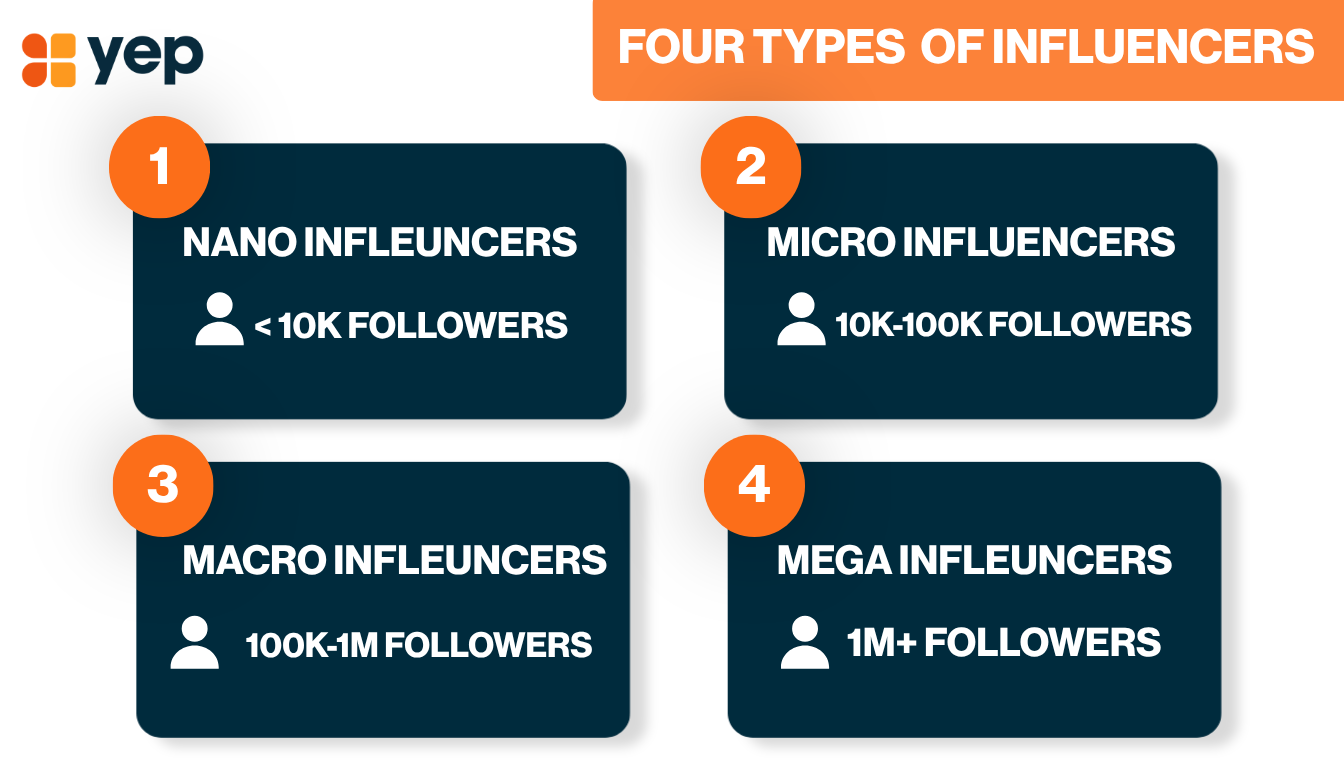
Tier definitions are not standardized. eMarketer draws nano at 1,000–4,999 followers; most agencies draw it under 10,000. Engagement rates vary by platform, methodology and vertical. The ranges below are directional.
Nano (~1K–10K followers)
Engagement runs 3–8%, the highest of any tier. Deals are gifting, a few hundred dollars, or CPA-only. This is where you buy UGC volume and cheap creative testing not reach.
Micro (~10K–100K followers)
Engagement sits at 2–5%, and rates run $200–$1,500 with hybrid flat-fee-plus-commission increasingly common. The workhorse tier: best cost per engagement, and enough production quality to run the output as paid creative.
Macro (~100K–1M followers)
Engagement drops to 1–2.5%. Expect $2,000–$25,000 plus usage rights. Worth the fee for launch moments, category credibility, and whitelisting-grade production you can put real ad spend behind.
Mega (1M+ followers)
Engagement falls under 1.5%, and fees start in five figures and climb past $200,000. You are buying reach spikes and brand recall. Price it as media, not as content.
Two principles sit underneath. First, engagement rate interactions divided by impressions or followers falls as audience size grows, but it is not a conversion metric. A nano creator with 6% engagement and 2,000 followers produces a few hundred interactions. That is a content buy with a distribution bonus attached, and it should be priced that way.
Second, the tier follows the goal. Need forty creative variants for a paid social testing calendar? You are buying nano and micro output. Need one credibility moment for a launch? Macro earns its fee. The failure mode is paying macro rates against a CPA scorecard.
The Five-Phase Framework for Building an Influencer Content Strategy
Phase 1: Set One Goal and the Metric That Proves It
Pick the outcome before the creator: asset volume, qualified reach, tracked revenue, or CPA cost per acquisition. Each implies a different brief, tier and contract. Programs chasing all four optimize none, and end up reporting likes. Write the metric down before outreach.
Phase 2: Source on Fit, Not Follower Count
ICP overlap the share of a creator’s audience resembling your ideal customer profile beats audience size on every metric that matters. Read the comments, not the follower count: product questions, or fire emojis? AI discovery, now the leading AI use case among influencer teams, narrows 300,000 profiles to 300. It cannot tell you whether that audience buys.
Phase 3: Brief for Authenticity, Contract for Performance
A brief should carry an objective, the two or three product truths that must survive, a hook direction and the format. Everything else belongs to the creator. Over-scripted content reads as advertising in a feed engineered to punish advertising.
The contract is where the strategy lives. Specify deliverables and raw file delivery, usage rights duration (twelve months if you are serious about paid), whitelisting permissions, exclusivity and compensation. Demand music-free raw video licensed audio blocks an organic post’s use as an ad.
Phase 4: Distribute Across Owned, Earned and Paid
This is where most programs quietly die: the content publishes, gets 48 hours, disappears. Repurpose it to paid social, then run creator whitelisting (or allowlisting), where ads run from the creator’s handle rather than the brand’s via Meta Partnership Ads, TikTok Spark Ads or YouTube Brand Connect. Meta’s partnership ads data shows roughly 19% lower CPA alongside business-as-usual campaigns; agencies claim 30–50%. The higher numbers come from vendors selling whitelisting test against your own baseline.
Then syndicate: the same asset belongs on the product page, in the welcome email, in retargeting, and cut for another platform’s aspect ratio. Our guide to media buying compares those paid channels.
Format performance varies by platform. Socialinsider’s 2026 Instagram benchmarks show carousels leading engagement at 0.52% with Reels at 0.50%, while Reels dominate reach. TikTok’s average engagement sits near 3.70% against Instagram’s 0.48% different feeds, not comparable.
| Format | Engagement | Reach | Best for |
|---|---|---|---|
| Short-form video | Moderate per impression | Highest | Cold acquisition, amplification |
| Carousel / multi-image | Highest per impression | Moderate | Saves, considered purchase |
| Long-form video | High intent, low volume | Low but durable | Reviews, evergreen discovery |
| Static image | Lowest | Low | Retargeting, offer reinforcement |
| Text / document post | Strong on LinkedIn only | Low | B2B expert positioning |
Phase 5: Measure the Asset, Not the Post
Track engagement rate by impression, not by follower. Track EMV earned media value, the paid-equivalent cost of organic impressions as context, never as a KPI. Track cost per acquired customer per creator, and creative fatigue: how long before an asset’s CPA drifts above target.
Infrastructure comes first: unique tracking links per creator, server-side postbacks, and a naming convention so whitelisted spend never collapses into one paid-social line item. If you cannot separate creator-handle from brand-handle ads in your tracking and analytics, you cannot know which is working.
Creator Content Inside an Affiliate Program: Why It’s Different
Affiliate marketing solved attribution a decade before influencer marketing needed it, and the two are converging. The Influencer Marketing Factory’s 2026 brand deals analysis found affiliate arrangements now account for 52.9% of collaborations on YouTube and 26.6% on TikTok. Hybrid structures base fee plus 10–15% commission are standard.
Be honest about the friction. Modash’s 2026 trends survey found the share of marketers reporting creators open to affiliate-only terms fell from 63% to 26% year over year. Conversion depends on your site speed, checkout and competing discounts. A flat fee prices the content; commission prices the outcome. Pay for both.
Attribution stays imperfect; cookie windows collapse, in-app browsers eat referrers. Run a tracking link and a promo code in parallel; 2026 data shows 45.9% of brands measure with promo codes against 26.0% using affiliate links. Managing 200 small partners across tracking, contracts, disclosures and multi-currency payouts is the infrastructure problem affiliate program management was built to solve.
Common Mistakes That Kill Creator Programs
- Running campaigns instead of systems. Every quarter restarts from zero, with no learning about which angles convert.
- Skipping usage rights. The asset performed, but you cannot run it as an ad. You own a 48-hour post and an invoice.
- Ignoring the long tail. Nano and micro is where volume, cost efficiency and category fit converge.
- Measuring likes. Engagement indicates content quality, not customer acquisition. Report CAC.
Final Thoughts
The return does not sit in any single post. It sits in the content library you accumulate and the speed of the loop that tells you which angles work You are not buying impressions, you are buying native, testable, rights-cleared creative with a distribution channel attached. It belongs alongside the rest of your performance marketing strategies, not in a separate brand budget.
A sequence for this quarter: pick one goal and one metric. Contract five to ten micro and nano creators on hybrid terms, with twelve-month usage rights and whitelisting written in. Push every asset into the ad account. Give it a full quarter; algorithms need weeks to produce readable CPA data. Then cut the bottom half of the creator-level CAC table.
How Yep Ads Approaches Creator Partnerships
Yep Ads builds creator and publisher partnerships on measurable, performance-based terms, helping advertisers turn creator output into durable acquisition assets rather than one-off placements.
Frequently Asked Questions
What Is Influencer Content Strategy?
Influencer content strategy is the repeatable system a brand uses to source creators, brief them, secure usage rights, distribute content across owned, earned and paid channels, and measure the result against acquisition metrics. It treats creator partnerships as a content engine, not a run of sponsored posts.
What’s the Difference Between Influencer Marketing and Influencer Content Strategy?
Influencer marketing is the activity: paying a creator to publish. Influencer content strategy is the structure around its goal definition, sourcing criteria, contract terms, distribution and measurement. One produces posts. The other produces a content library and a feedback loop that improves creative performance.
How Do You Measure Influencer Content ROI?
Measure the asset, not the post. Track cost per acquired customer per creator using unique links and promo codes, engagement rate by impression, and creative fatigue how long an asset holds its CPA as paid media. Earned media value is context, not a return figure.
Should Influencer Deals Be Flat Fee or Performance Based?
Both. Hybrid structures: a reduced base fee plus commission on tracked sales are standard, because flat fees price the content and commission prices the outcome. Pure affiliate terms meet creator resistance, since conversion depends on factors outside their control. A base fee plus 10–15% commission is a reasonable start.
How Does Creator Whitelisting Work?
Whitelisting means running paid ads from a creator’s handle instead of your brand’s. The creator grants access via Meta Partnership Ads, a TikTok Spark Ads code, or YouTube Brand Connect, while your team controls targeting and budget. Ads look native and typically beat brand-handle creative.
You Might Also Like
- Influencer Marketing and Affiliate Campaigns
- What Is Performance Marketing?
- Brand Building vs Short-Term Performance
- How to Get Affiliates: 12 Proven Strategies
- Credit Card Affiliate Programs in 2026
- UGC in Nutra Marketing: How Short-Form Video Builds Consumer Trust
Work With Yep Ads
Yep Ads manages performance-based advertising programs through a vetted network of publishers, creators, and media buyers. Talk to our team to explore how we can support your growth goals.
Share