
LLM Advertising Wave: New Acquisition Channel
Your next customer may never click a search ad again. Instead, they will ask ChatGPT what to buy, and trust the answer. Large Language Models are changing how people discover products, compare options, and make decisions. And with that shift comes a completely new advertising channel: LLM advertising. Brands that understand this early will have a major competitive advantage.
Whether you’re a brand looking to get ahead of the curve or an affiliate exploring new traffic sources, this guide covers everything you need to know about how LLM ads work, who they’re for, and how to prepare.
Table of Contents
- What Is LLM Advertising?
- LLM Ads Launch Timelines: What’s Coming and When
- How Will Ads Look on LLM Platforms?
- How Is LLM Search Advertising Different Than Traditional Search Engines?
- What Types of Targeting Options Can We Expect in LLM Ads?
- Understanding the LLM User (And Why They’re Not Like Search Users)
- How to Prepare Your Brand
- FAQs
What Is LLM Advertising?
For the first time, advertising is entering personal conversations, not just search results.
LLM advertising refers to paid promotional content displayed within Large Language Model platforms like ChatGPT, Claude, Google Gemini, Perplexity etc. This is not theoretical. It is already happening. Unlike traditional search or display advertising, LLM ads appear within conversational interfaces where users are actively seeking answers.
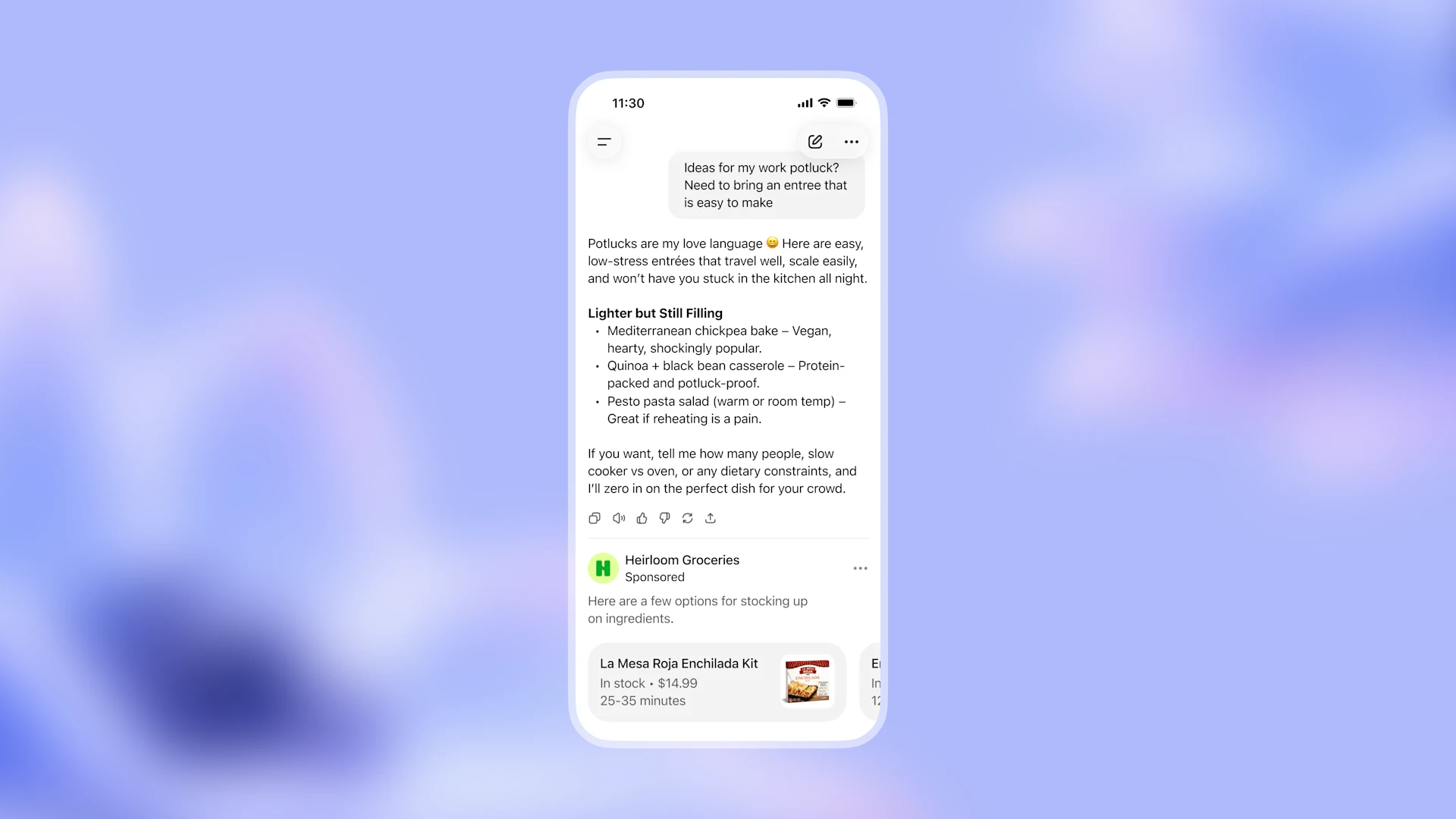
Source:https://openai.com/index/our-approach-to-advertising-and-expanding-access/
Here’s the shift: people don’t want to search for what they want to find. More than that, they want to know, understand, and make decisions. Traditional search engines provide links to sources, leaving users to sift through results. LLMs deliver direct answers, synthesizing information into conversational responses tailored to user intent.
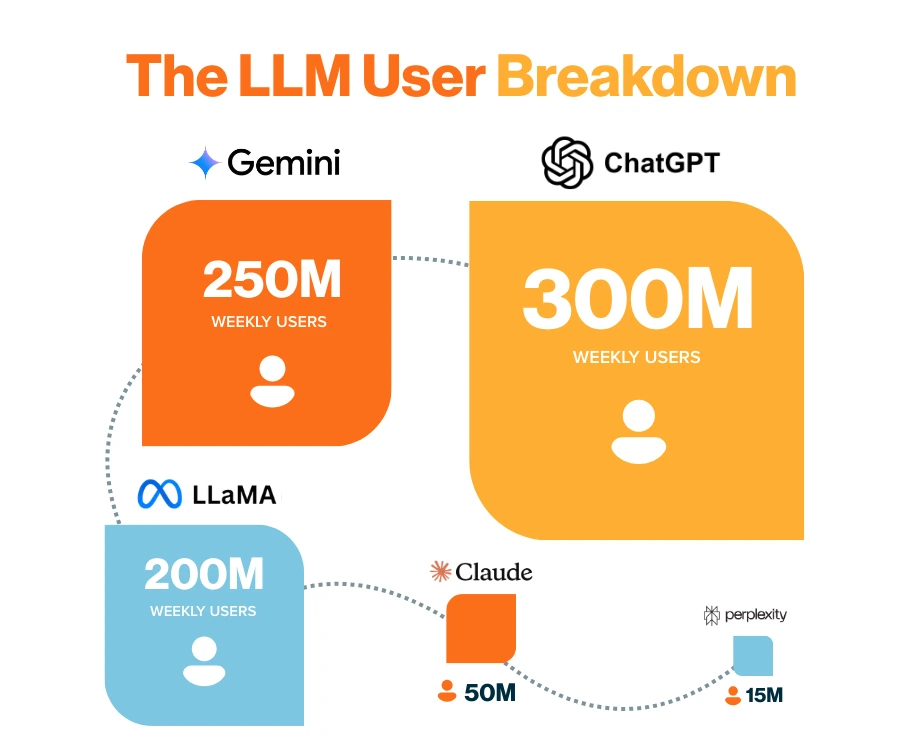
(Sources: BI, Reuters, Gemini estimate based on 106M app downloads plus 275M monthly visits plus integration into Google tools such as Gmail and Meet: 9M organizations, Llama estimate based on Mark Zuckerberg’s recent statement that Llama was serving 600M users monthly, Claude extrapolation from SimilarWeb, plus app usage, FT)
Source: YepAds
Most Relevant LLMs ChatGPT, Perplexity and more
- ChatGPT by OpenAI: 300M weekly users
- Gemini by Google: 250M weekly users
- Llama by Meta: 200M weekly users
- Claude by Anthropic: 50M weekly users
- Perplexity AI: 15M weekly users
LLM Ads Launch Timelines: What’s Coming and When
Advertising inside AI platforms is no longer a future concept. It has already started rolling out. Here’s what we know about LLM advertising rollouts across the major platforms:
ChatGPT (OpenAI)
- February 2026: Ads launched for U.S. free-tier and Go ($8/month) users
- OpenAI’s official announcement on ChatGPT ads
- 2026: Broader expansion expected, new formats, and potentially a self-serve ad platform
- 2029: OpenAI projects $25 billion in ad revenue (yes, billion with a B)
Google Gemini
- No ads currently in the Gemini app: Google’s VP of Global Ads confirmed in December 2025 “there are no ads in the Gemini app and there are no current plans to change that”
Perplexity
- Were testing in 2024-2025 but decided to stop to build more trust: Sponsored follow up questions and branded answers were in beta
- Paused new advertisers in October 2025, then fully abandoned advertising in February 2026, citing trust concerns
Meta (Llama)
- Not a standalone ad platform yet, but Llama powers AI across Instagram, WhatsApp, and Facebook
- Ads already surround Llama-powered features within Meta’s apps, but Llama itself doesn’t have a separate advertising product
Claude (Anthropic)
- Committed to remaining ad-free (announced February 2026 with Super Bowl campaign)
- Anthropic stated: “There are many good places for advertising. A conversation with Claude is not one of them”
How Will Ads Look on LLM platforms?
This raises one of the biggest questions advertisers are asking: Where will their brand actually appear? While formats are still evolving, early implementations and official announcements already give us an idea:
- Sponsored citation/sources paid links appearing alongside organic sources in the response (Perplexity does this)
- post response display ads banner or card style ads shown below the answer
- Sidebar Placements – ads displayed in a dedicated side panel while the conversation unfolds
- Sponsored answers – entire responses generated on behalf of a brand, marked as a sponsored content
- In line product recommendations – native mentions woven into the answer itself, clearly labelled as sponsored
- Interactive product cards rich media cards with images pricing and purchase buttons embedded in responses
How is LLM search advertising different than traditional search engines
While formats are still evolving, early implementations and official announcements already give us a clear picture
LLMs are much different and more than traditional search engines. These differences show us what will change in an LLM search advertising platform. Traditional search engines help users search. LLMs help users decide. .Users on LLM’s want to FIND, they want to know, understand, converse, or to make a decision or a purchase.
With Traditional engines providing links to sources retrieving and ranking web pages, leaving users to scroll through pages of the results tab. Conversely LLM’s give direct answers. It composes information into a conversational, factual response without requiring the user to browse and sift through pages of different sources. While search engines are great at finding web content, these models understand the entire context of your conversation and are heavily tailored to your specific intent. Search engines have already started implementing similar synthesized answers like Google’s AI overview but LLM’s have taken this to a different level.
What Types of Targeting Options Can We Expect in LLM Ads?
For advertisers, this unlocks something far more powerful than keyword targeting: intent-level targeting.
- Untargeted brand ads – Some offers convert across almost any audience. A mass-market supplement or credit card with universal appeal could run broad, untargeted placements and still see volume.
- Contextual targeting – Someone asking how to reduce credit card debt is already in the mindset for a balance transfer offer. A user researching home workouts might be one message away from a fitness app trial.
- Behavioral targeting – Over multiple sessions, an LLM learns a user is a small business owner interested in scaling. That’s a warm audience for invoicing software, business insurance, or lead generation tools all high value affiliate verticals.
- Broad keyword matching – Forget exact match keywords. LLMs understand intent, even when the user never mentions your product directly.. If someone asks “how do I stop my dog from scratching so much,” the LLM understands they’re a pet owner with a pain point perfect for a pet supplement or flea treatment offer, even though they never typed those product keywords.
Understanding the LLM User (And Why They’re Not Like Search Users)
The person typing into ChatGPT is not the same as the person typing into Google.
Search users are hunting. LLM users are making decisions.
When someone Googles “best email marketing platform,” they’re starting a research process clicking through tabs, skimming articles, maybe coming back tomorrow.
When someone asks ChatGPT “I run a DTC skincare brand, I’ve outgrown Mailchimp, and I need better segmentation without hiring a developer” they’ve already defined the problem and they’re ready for an answer.
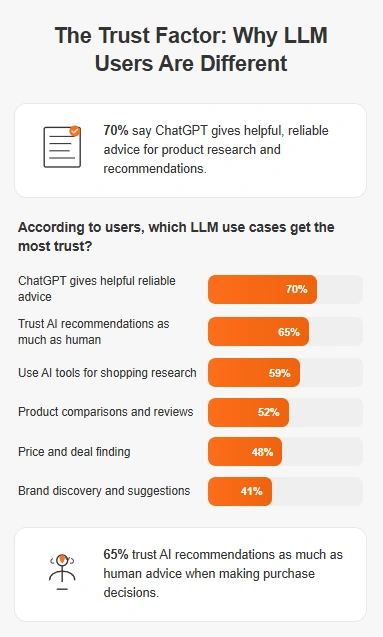
The trust factor is real
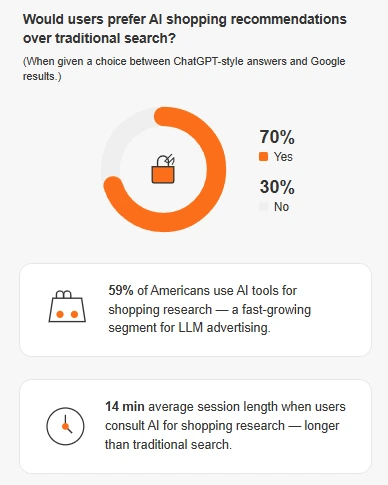
- 70% of users say ChatGPT gives helpful, reliable advice
- 65% trust AI recommendations as much as human advice for purchases
- 59% of Americans already use AI tools for shopping research
- Average session length is nearly 14 minutes deep, focused engagement
Source: YepAds
How to Prepare Your Brand for AI Ads
Most brands are not preparing yet. That creates an opportunity.
1. Identify Which Verticals Would Benefit From AI Ads The Most
Some verticals will benefit massively from LLM advertising. Others may not, at least not immediately. LLM advertising isn’t going to be the right fit for everyone. So don’t go throwing money at LLM ads immediately. Here are some verticals/offers that have serious potential:
Products that require research – Think enterprise software, financial products, healthcare solutions, higher education. If your customers spend time comparing options and reading up before they commit, LLM platforms are where those conversations are already happening.
B2B with longer sales cycles – If closing a deal means walking buyers through features, addressing concerns, and building trust over time, the conversational nature of ChatGPT plays right into your strengths.
E-commerce where choice overload is real – Categories like electronics, home goods, and specialty products where people genuinely need help narrowing down options. LLMs are becoming the go-to for “which one should I actually buy?”
Travel and hospitality – This one’s already proven. ChatGPT is influencing 18% of travel purchase decisions. Users are planning entire trips, comparing destinations, and booking based on AI recommendations.
Where it might not make much sense for now:
- Low-cost impulse buys where there’s no research phase
- Pure brand awareness campaigns without a clear conversion goal
- Heavily regulated industries that might trigger content restrictions around sensitive topics
2. Prepare Creatives That Match The Conversational Nature of LLMs
Here’s what brands might overlook and screw up: they take their current copy and approach from Google Ads and copy paste into ChatGPT ads
This approach will not work in conversational environments.
With understanding the nature of these conversational LLM’s ads needs to feel like recommendations, not interruptions, you’re quite literally entering someone’s conversations, you need to account for that.
What Works
- If you’re dealing with [problem],[product] is built for exactly that. Here’s what it does….
- Direct, useful and tied to what the user was actually inquiring about
- Matching the conversational tone (detailed for detailed questions), and relaxed for more laid-back casual questions)
What You Should Avoid
- HUGE SAVINGS! BUY TODAY! DONT MISS OUT!
- Broad claims that aren’t contextualized to their specific intent of the problem the user is trying to solve
- Copy that was written for different purpose ie(sales poster)
Another thing that LLMs like OpenAI have hinted at is that users might be able to converse and ask questions to the ads. Which means your copy needs to withstand the interrogation, if someone asks “is this a fad or does it really work, and how?” “What’s the catch?” you need to be prepared.
3.Optimize Your Content for AEO
Before spending money on LLM ads, there is something even more important: organic visibility. You might think it doesn’t matter but it does. If ChatGPT recommends your competitor in its answer and then lists your sponsored ad underneath this is a massive issue. You’re paying to be the last recommendation under organically ranked suggestions. Brands already mentioned organically will have a major advantage when paid ads scale.
RUN an AEO audit
- Is your brand mentioned when people ask a chatbot about your category? You can test this for yourself. Search a detailed prompt “whats the best product for ____ specific issue/category) and see what the results are.
- Do you have clear information on your site? ChatGPT pulls from content it can easily process, product descriptions, prices etc
- Are you naturally mentioned on third-party sites?
- ChatGPT weighs multiple sources from the web, discussion websites, Reddit, review blogs and sites, publications, and LLMs take these things in to account
- Is your content recent? 95% of your ChatGPT citations come from content that has been updated in the past 10 months, stay on top of content; old content gets ignored.
4. Prepare the Launch Strategy
Do this now:
- Ask ChatGPT questions about your product category and see if your brand comes up organically
- Tighten up your positioning if you can’t describe what you offer in a single clear sentence; fix that first
- Make sure your tracking and attribution setup is ready for a new traffic source
Over the next few weeks and months:
- Map out the types of conversations your ideal customers are having (what questions do they ask before buying?)
- Start drafting ad copy that sounds like a helpful suggestion, not a sales pitch
- Get your team up to speed on how conversational advertising works differently
- Earmark some test budget somewhere in the 5-10% range of your current paid spend
Before the platform opens up:
- Make your landing page congruent with the AI conversation that sent them there
- Build out FAQ style content that could support back-and-forth ad interactions
- Define success metrics that account for this being a brand-new, experimental channel
- Put together a proper testing framework so you’re learning, not just spending
Final Thoughts
A new advertising channel is emerging faster than most brands realize. The shift from search to conversation is already happening. Users aren’t browsing through pages of results anymore; they’re asking AI for direct answers and trusting what they get.
For brands, the opportunity is clear: get ahead now. Start optimizing for organic LLM visibility, rethink your creative for conversational formats, and be ready to test when these ad platforms open up.
Want help preparing for what’s next? Work with Yep Ads to build a strategy ready for the AI advertising era.
You Might Also Like
- ChatGPT Ads: How They’ll Work + How Brands Should Prepare (2026)
- Ads Are Coming to ChatGPT: New OpenAI Announcement
- Buy on LLMs & Agentic eCommerce: What It Means for Brands
- How to Get Found on ChatGPT and Google AI
- Marketing Trends & Predictions for 2026
FAQs About LLM Ads
Do ads influence ChatGPT’s answers?
No. OpenAI explicitly states ads don’t influence responses. Ads appear separately, clearly labeled, after the organic answer.
Which LLMs will have ads?
Expect major LLMs to consider offering an ad platform in the near future. Chat GPT ads are now live, Meta and Perplexity could be next to launch.
How are LLM ads different from traditional search ads?
LLM ads are integrated directly into the AI-generated responses rather than appearing as listings on their own. This creates an ad experience that is more contextual and conversational compared to keyword-based search ads on Google.
Share
