
CPM Meaning in Digital Marketing
CPM is what you pay for a thousand ad impressions, and it is the oldest pricing model in media. This guide covers how the number is calculated, what it hides once viewability is applied, and when buying impressions beats paying for clicks or conversions.
Definition
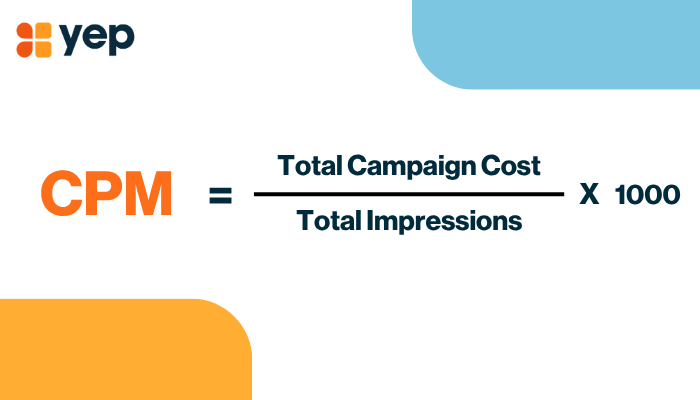
CPM (cost per mille) is the price an advertiser pays for 1,000 ad impressions. It is the standard unit of impression-based pricing, calculated as (total ad spend ÷ impressions) × 1,000, and it is what publishers charge to sell inventory as well as what buyers pay to reach an audience.
Credit: Yepads
Основные выводы
- CPM is the cost of 1,000 impressions: (spend ÷ impressions) × 1,000.
- Impressions, page views and reach differ and served is not viewable.
- CPM wins when conversion math is known and creative proven; its risks are unviewable inventory, opaque placements and invalid traffic.
- Publishers judge inventory on eCPM, balancing fill against floors
What counts as an impression
An impression is one instance of your ad being served into a page or app not the same as a viewable one. Under the MRC viewable impression standard, a display ad is viewable when 50% of its pixels are in view for one continuous second, two for video. Plenty of served impressions never clear that bar.
Impressions vs. page views vs. reach
A page view counts the page loading; an impression counts a slot filling, so three units make three impressions per view. Reach counts unique people: 10,000 impressions at a frequency of four reaches 2,500.
How to Calculate CPM
(Total ad spend ÷ impressions) × 1,000 = CPM
Spend $6,000 for 1,200,000 impressions: 6,000 ÷ 1,200,000 = 0.005, times 1,000 = a $5 CPM. Reversed, budget ÷ CPM × 1,000 projects volume.
CPM vs. eCPM for publishers
eCPM, or effective CPM, normalises revenue from any deal type into a per-thousand figure. A CPA placement paying $600 across 400,000 impressions returns a $1.50 eCPM — comparable with a $2 CPM slot. It is how a publisher with mixed demand decides what earns the best slot.
CPM vs. CPC, CPA, CPL, and CPV
| Model | You pay for | Best used when | Main risk |
| CPM | 1,000 impressions | Awareness, proven creative | Impressions that don’t convert |
| CPC / PPC | Each click | Driving qualified traffic | Clicks that don’t convert |
| CPA | An action or sale | Direct response economics | Higher unit cost, tighter supply |
| CPL | A qualified lead | Lead gen with sales follow-up | Lead quality varies |
| CPV / CPI | A view or install | Video reach, app growth | Installs with no retention |
Each model shifts risk between buyer and seller. On CPM the advertiser carries it; on CPA the publisher does, which is why that inventory costs more per unit. So it is a data question: know your click-through and conversion rates and CPM is often the cheapest route to the same result. If not, buy on performance.
What Is a Good CPM?
There is no universal number, and any benchmark you find is a snapshot of someone else’s campaign. Rates move with channel, geography, targeting depth, format, inventory quality, competition and season. The general shape holds, though: open-exchange display sits at the low end, curated private-marketplace and native inventory clears it comfortably, and CTV commands the premium tier.
So treat published benchmarks as a starting point for negotiation, not a target to hit. A good CPM is one that produces an acceptable cost per acquisition. Cheap inventory that never converts is the more expensive buy at a higher rate that fills the funnel does the job the budget was there to do.
Benefits and Drawbacks of CPM Advertising
The upside: predictable budgeting, reach at a scale click pricing cannot match, fast data that makes creative testing cheap, and premium inventory not sold on performance.
The downside: you pay regardless of outcome, placement quality can be opaque, and some impressions are never viewable. Invalid traffic is a live problem measurement firms put programmatic IVT in the high teens to low twenties as a share of impressions, higher in mobile app and CTV. Buyers protect themselves with third-party verification, contracted viewability thresholds, block lists, reputable partners and audits of wasted ad spend.
It fits awareness goals, proven creative and known conversion math. It suits thin targeting and tight CPA targets badly there, CPA-маркетинг is safer.
CPM for Publishers: Turning Impressions Into Revenue
On the supply side, CPM is what you charge for ad inventory. Fill rate the share of ad requests filled and floor pricing, your minimum acceptable CPM, decide how much of it earns. Floors too high collapse fill; too low, you sell premium placements cheaply.
What lifts your rates is quality: engaged audiences in strong geos, placements that clear viewability, clean traffic, brand-safe content. Stacking units raises impressions and damages eCPM our publisher network balances both.
How to Run a Successful CPM Campaign
- Set the budget and success metric CPA, ROAS or lift before launch.
- Define the audience and inventory standards, including viewability minimums.
- Pick the partner that fits the goal media buying options differ by channel.
- Launch on a test budget, with creative built for the placement.
- Read placement-level data weekly, cut weak domains, then scale.
FAQ
What does CPM mean in digital marketing?
CPM means cost per mille, or cost per thousand impressions: a model where an advertiser pays a fixed rate for every 1,000 times an ad is served, regardless of clicks or conversions.
How do you calculate CPM?
Divide total ad spend by impressions delivered, then multiply by 1,000. A $6,000 campaign serving 1,200,000 impressions has a $5 CPM. To forecast delivery, divide the budget by the quoted CPM.
Does a low CPM always mean a better campaign?
No. Cheap impressions often come from low-viewability placements or weak supply. A higher CPM on well-targeted, viewable inventory usually delivers a lower cost per acquisition the number that decides whether it worked.
Вам также может понравиться
Поделиться
