
Omnichannel Advertising in 2026: Channels and Examples
Last Updated July 2026
Omnichannel advertising is a coordinated approach that delivers consistent ads and messaging across multiple channels throughout the customer journey.
An omnichannel marketing strategy is a coordinated approach that creates a consistent customer experience across all channels and touchpoints.
The fastest-growing brands are not always the ones advertising on the most platforms or spending the most money. They are often the ones creating a consistent, connected experience wherever customers choose to research, compare, and buy.
Consumers now move naturally between search engines, social media, AI assistants, review websites, marketplaces, email, connected TV, mobile apps, and physical stores before making a purchase. New acquisition opportunities also continue to emerge, including AI-powered discovery, creator commerce, retail media, and card-linked offers. As a result, modern marketing is becoming less about winning on one platform and more about appearing consistently throughout the customer journey.
This guide explains what omnichannel advertising means, how it differs from multichannel marketing, why it matters in 2026, and how businesses can build an advertising ecosystem that works together instead of functioning in silos.
Основные выводы
- Omnichannel advertising connects customer touchpoints into one consistent experience rather than treating each channel independently.
- Most purchasing decisions now involve several platforms, messages, and interactions before a conversion occurs.
- Search, social media, affiliate marketing, content, email, retail media, creator partnerships, and AI discovery can support different stages of the same journey.
- The goal is not to advertise everywhere. It is to appear in the right places with consistent messaging.
- Channels should support one another rather than compete for attribution.
- Successful omnichannel strategies require coordinated messaging, shared data, customer-focused measurement, and continuous testing.
Оглавление
- What Is Omnichannel Advertising?
- Why Omnichannel Advertising Matters
- Omnichannel vs. Multichannel Advertising
- Understanding the Modern Customer Journey
- The Core Channels of an Omnichannel Strategy
- Where Affiliate Marketing Fits
- Заключительные размышления
- Часто задаваемые вопросы
What Is Omnichannel Advertising?
Omnichannel advertising is a strategy that creates a coordinated experience across the channels where customers interact with a brand.
Instead of treating search, social media, email, affiliate marketing, content, retail media, and other channels as unrelated campaigns, an omnichannel approach connects them around a shared customer journey.
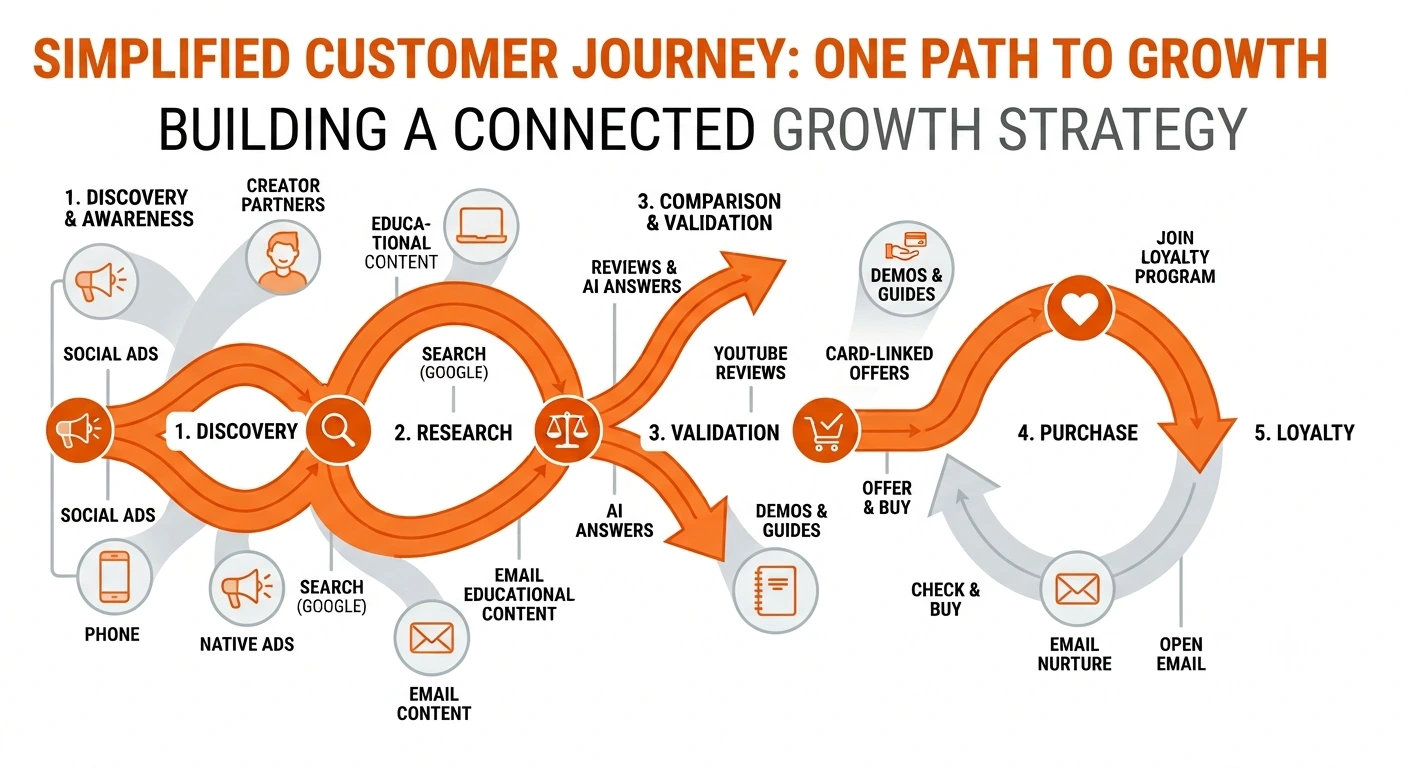
For example, someone might first discover a product through a creator on Instagram. Later, they search Google to learn more, ask an AI assistant for recommendations, read a comparison article from a trusted publisher, receive an educational email, and eventually convert after seeing a relevant offer. From the customer’s perspective, they are dealing with one brand, even though several platforms and partners are involved behind the scenes.
That is the difference between running multiple campaigns and creating one connected growth strategy.
Source: Yep Ads
Why Is Omnichannel Advertising Important?
Consumer behavior has changed significantly. People rarely move through a simple, predictable funnel. Instead, they research across multiple devices, compare recommendations from different sources, revisit brands several times, and often spend days or weeks making a decision.
Someone shopping for business insurance might begin with a Google search, compare providers on review websites, ask an AI assistant to explain policy differences, watch a video, return to a company’s website after seeing a social ad, and finally submit a request after receiving a follow-up email.
На сайте Мы, we view every marketing channel as having a different role. Search captures existing intent. Social media creates discovery. Affiliate partners provide trust and third-party validation. Native advertising educates potential customers. Email nurtures relationships. Card-linked offers can encourage measurable purchases, while AI-powered discovery introduces brands during new moments of research and consideration.
When these channels support one another instead of operating in isolation, brands can create more efficient acquisition strategies, stronger customer relationships, and more resilient long-term growth.
The Goal Is Not More Advertising. It Is Better Advertising.
Running campaigns across ten disconnected platforms does not automatically create an omnichannel strategy. Spreading budgets too thin can make marketing less effective.
Successful omnichannel advertising focuses on continuity.
Each channel should serve a clear purpose while reinforcing a consistent value proposition.
For example:
- Social media introduces the brand.
- Search captures active demand.
- Content answers customer questions.
- Affiliate publishers provide third-party validation.
- Email nurtures prospects and existing customers.
- Native advertising supports education and discovery.
- Retail media reaches customers closer to a purchase.
- Card-linked offers provide an additional reason to buy or return.
Each interaction contributes something different, but all of them guide customers toward the same destination.
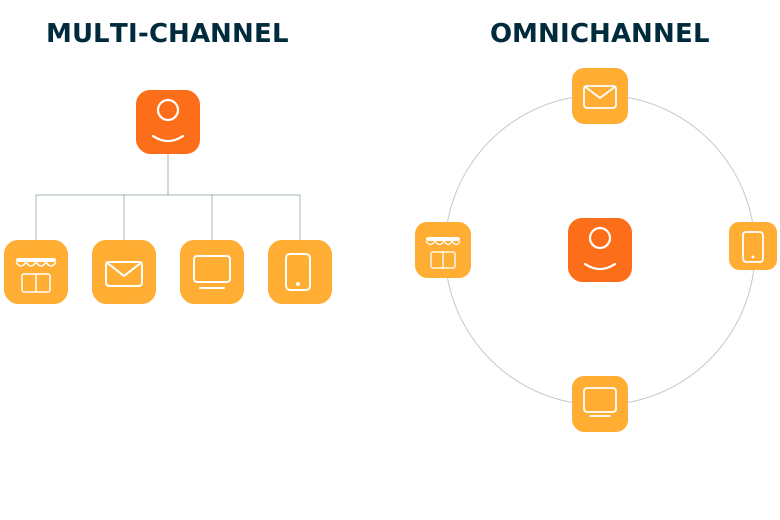
Omnichannel vs. Multichannel Advertising
The terms “multichannel” and “omnichannel” are sometimes used interchangeably, but they describe different approaches.
Multichannel advertising means using several marketing channels.
For example, a company might run Реклама Google, publish content on LinkedIn, send email campaigns, and manage an affiliate program at the same time. However, each channel may have separate goals, messaging, teams, and reporting.
Omnichannel advertising goes further.
It coordinates those channels around the complete customer journey.
| Multichannel Advertising | Omnichannel Advertising |
| Uses multiple channels | Connects multiple channels |
| Channels often operate independently | Channels support one another |
| Focuses on individual campaigns | Focuses on the customer journey |
| Messaging may vary by team | Messaging follows shared positioning |
| Measures channels separately | Examines cross-channel influence |
| Easier to launch | More strategic to manage |
| Builds channel presence | Builds a connected experience |
Understanding the Modern Customer Journey
People move between platforms, revisit brands multiple times, ask follow-up questions, compare alternatives, and sometimes return weeks later before converting.
Source: Yep Ads
A Modern Customer Journey Example
Imagine someone shopping for a standing desk for their home office.
They may:
- Discover a brand through an Instagram Reel.
- Search Google for the best standing desks for back pain.
- Read a comparison article from a publisher.
- Ask an AI assistant which option offers the best value.
- Watch two YouTube reviews.
- Visit the brand’s website without buying.
- See a retargeting ad the following week.
- Receive an email containing a buyer’s guide.
- Complete the purchase after discovering a cashback offer.
At first glance, those interactions might seem unrelated. From the customer’s perspective, however, they form one continuous experience. Every relevant touchpoint can reduce uncertainty and increase confidence until the customer is ready to make a decision.
The Core Channels of an Omnichannel Advertising Strategy
In a successful omnichannel strategy, each channel has a different role, and the strongest strategies combine them intentionally rather than expecting one platform to do everything.
Search Advertising – Search campaigns help brands appear when potential customers are actively looking for information, products, or services. Search also frequently benefits from activity on other channels.
Paid Social – Platforms such as Facebook, Instagram, LinkedIn, TikTok, Pinterest, and Reddit are effective for creating awareness and discovery. Strong creative, storytelling, and audience targeting help brands generate demand that may later convert through search, email, affiliate partners, or direct website visits.
Content Marketing and SEO – Educational articles, buying guides, comparison pages, research, case studies, and product explainers answer the questions customers ask throughout the decision-making process. Strong content can support paid campaigns, organic search visibility, sales conversations, email marketing, and publisher partnerships.
Email Marketing – Within an omnichannel strategy, email is especially valuable for nurturing prospects, educating potential buyers, communicating offers, onboarding customers, and encouraging repeat purchases.
Native Advertising – Нативная реклама allows brands to appear naturally alongside the content people are already consuming. Native advertising can be particularly effective during the awareness and research stages, when customers are gathering information rather than preparing to make an immediate purchase.
Retail Media – Retail media allows brands to advertise within retailer-owned websites, apps, marketplaces, and other commerce environments. Retail media is especially valuable for consumer brands that need to influence product discovery, comparison, and purchasing decisions inside a retail ecosystem.
Affiliate Marketing – Affiliate marketing has a unique role within an omnichannel strategy because it can support several stages of the customer journey.
Affiliate partnerships can connect brands with:
- Content publishers
- Product-review websites
- Comparison platforms
- Творцы и авторитеты
- Email publishers
- Loyalty communities
- Coupon partners
- Cashback platforms
- Technology partners
Each type of partner reaches customers differently.
Affiliate marketing is built around performance and partnerships rather than relying exclusively on interruption-based advertising. It allows brands to appear within environments customers already use for information, recommendations, savings, and decision-making.
That is why affiliate marketing can complement search, social, content, email, and retail media instead of competing with them.
Emerging Omnichannel Opportunities
Customer journeys continue to evolve, and the channels influencing them evolve as well.
Brands that test relevant opportunities thoughtfully may develop an advantage before those channels become crowded.
That does not mean chasing every trend. It means understanding how new discovery and purchasing behaviors could fit into the broader customer journey.
AI-Powered Discovery
Consumers are increasingly using AI assistants and AI-enhanced search experiences to research products, compare services, summarize information, and ask detailed follow-up questions.
Instead of visiting several websites individually, users may begin with a conversational request and use the response to narrow their options.
This creates an additional discovery environment for marketers.
Traditional SEO remains important, but brands should also ensure that their information is:
- Clear and easy to understand
- Factually accurate
- Consistent across the web
- Supported by credible evidence
- Structured around real customer questions
- Accessible to search engines and other discovery systems
No company can guarantee inclusion in AI-generated responses.
However, publishing authoritative content and building a credible digital presence can improve the likelihood that a brand is discovered, understood, or referenced during AI-assisted research.
Creator Commerce
Social content and online shopping are becoming more closely connected. Creators can introduce products, answer questions, demonstrate how they work, and direct audiences toward purchasing opportunities without forcing customers to leave the content experience immediately. Affiliate-based creator partnerships can also give brands a performance-focused alternative to fixed sponsorship arrangements. Rather than paying only for exposure, companies can structure partnerships around measurable outcomes such as qualified traffic, leads, or sales.
Card-Linked Offers
Card-linked offers allow eligible customers to receive rewards or savings automatically when they use a linked payment card. These offers may appear in banking apps, loyalty programs, cashback platforms, and other financial-rewards environments. Because customers do not always need to remember a coupon code or click a particular link, card-linked offers can reduce friction. They may support acquisition, conversion, reactivation, or repeat purchasing, depending on how the campaign is designed.
Заключительные размышления
Omnichannel advertising is not about appearing everywhere. It is about creating a connected and consistent experience wherever customers choose to interact with a brand. The strongest omnichannel strategies begin with the customer.
Часто задаваемые вопросы
What is omnichannel advertising?
Omnichannel advertising is a strategy that coordinates a brand’s messaging and customer experience across multiple channels. It connects platforms such as search, social media, affiliate marketing, email, native advertising, retail media, and other touchpoints around one customer journey.
What is the difference between omnichannel and multichannel advertising?
Multichannel advertising means using several marketing channels. Omnichannel advertising connects those channels so that their messaging, data, and customer experiences support one another.
Multichannel focuses on channel presence. Omnichannel focuses on customer continuity.
Does omnichannel advertising mean advertising everywhere?
No. An omnichannel strategy should use the channels that are relevant to the brand’s customers and business objectives. Advertising on too many disconnected platforms can waste budget and create an inconsistent experience.
What role does affiliate marketing play in omnichannel advertising?
Affiliate marketing can support discovery, education, comparison, conversion, loyalty, and retention. Publishers, creators, comparison websites, review platforms, coupon partners, and cashback communities can introduce brands and influence purchasing decisions at different stages of the customer journey.
How does AI affect omnichannel advertising?
AI assistants and AI-enhanced search experiences are creating additional ways for customers to research products, compare services, and discover brands.
Companies should continue investing in useful, accurate, structured, and authoritative content. However, no strategy can guarantee that a brand will appear in AI-generated responses.
How should brands measure omnichannel performance?
Brands should examine customer acquisition cost, customer lifetime value, assisted conversions, retention, incrementality, conversion rates, and cross-channel journeys.
Platform attribution can provide useful information, but it should be supported by controlled testing and business-level measurement.
What is the first step in building an omnichannel strategy?
Identify where customers discover the brand, how they research alternatives, what prevents them from buying, which interactions build confidence, and what encourages repeat purchases. Then assign each channel a specific role based on those findings.
Вам также может понравиться
- How to Increase Lead Quality
- CPA Marketing Guide
- Что такое эффективный маркетинг?
- Home Improvement Leads Generation
- Google Ads for Lead Generation
- What Is Influencer Content Strategy?

Поделиться