
Preparing Your Q1 Marketing Strategy
While you’re wrapping up the office parties, finalizing last-minute shopping, and planning family celebrations, make some time for the Q1 planning. December can be a perfect strategic pause to reflect on the year and build a Q1 marketing strategy.
The first quarter of the year is not a moment for rest; it is your primary strategic opportunity to build strong momentum for the entire year. A successful Q1 strategy expertly transforms the energy of holiday spending into reliable, profitable growth by prioritizing data excellence, privacy-smart personalization, and inspiring content execution.
You might also like:
- Marketing Trends & Predictions for 2026
- 25+ High-Impact New Year’s Marketing Ideas
- Who Can Become an Affiliate & How to Get Started in 2026
Key Takeaways
- Conduct a detailed performance audit and plan content, securing a huge advantage over competitors who wait until January.
- Focus on solutions, self-improvement bundles, and treating returns/gift card use as opportunities to secure long-term loyalty.
- Align your messaging with major Q1 cultural moments (Black History Month, International Women’s Day, Spring Equinox) to boost engagement and relevance.
Table of Contents
- Your Winning Foundation (December Action)
- Review Q4 Performance (Time to Check Your Benchmarks)
- Optimize the Post Purchase Experience: Turning Transactions into Loyalty
- Strategic Content & Q1 Alignment
- Capitalize on New Year’s Goals (The Transformation Niche)
- Seize Q1 Cultural Moments
- Activate User Generated Content (UGC): The Power of Authenticity
- Budgeting for High ROI
- Implement the Fixed vs. Flexible Budget Rule
- Power Growth Through Owned Media and Data Driven Paid Ads
- Map Out Your 90 Day Content Matrix: Consistent Messaging Drives Results
Time to Audit: Build Your Winning Q1 Foundation
A winning Q1 strategy is brilliantly crafted in December. The focus of this foundational phase is on detailed performance review and ensuring data is ready the keys to confident scaling.
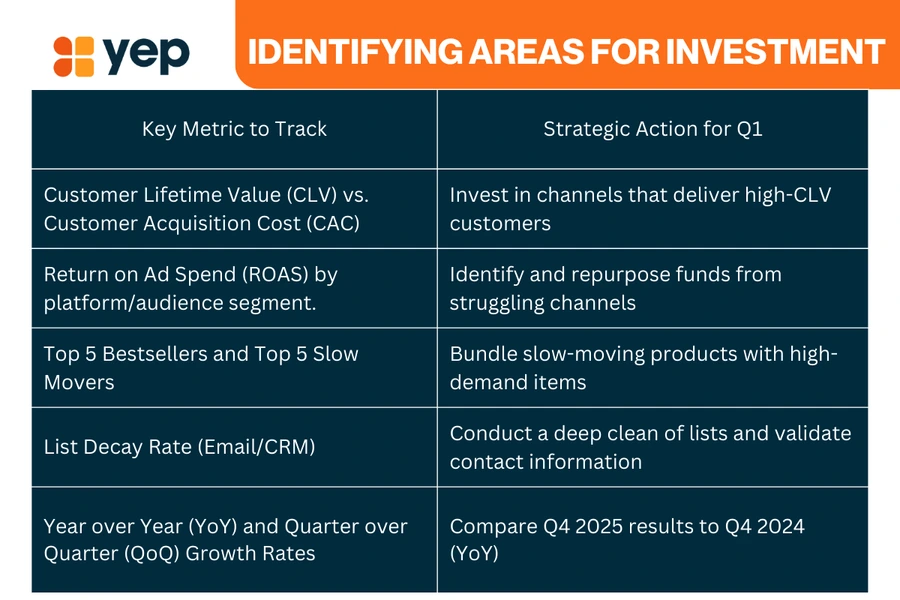
1. Review Q4 Performance Time to Check Your Benchmarks
Look beyond basic revenue. Analyze the quality of Q4’s success and compare data to identify the most promising areas for future investment.
2. Optimize the Post-Purchase Experience: Turning Transactions into Loyalty
In many sectors, Q1 involves managing returns and gift card use. View these moments as great opportunities to secure lasting customer relationships.
- Returns Management: Make the returns process remarkably easy and clear. A positive return experience is a powerful indicator of trust and can effortlessly convert a one-time buyer into a highly loyal, retained customer.
- Gift Card Strategy: Execute targeted email and social campaigns in mid-January, proactively prompting gift card use. Boost usage and drive upsells with enticing incentives: “Redeem your $50 card today and unlock free shipping on all orders over $75.”
Time to Plan: Strategic Content that Meets the Q1 Mindset
The emotional shift from Q4’s spending spree to Q1’s focus on self-improvement is huge. Your content must perfectly align with the customer’s optimistic “Fresh Start” mentality.
1. Capitalize on New Year’s Goals (The Transformation Niche)
Nearly half of consumers set goals. This is peak intent! Your mission is to link your product or service directly to their desired success and transformation whether health, finance, or productivity.
- Goal-Focused Content: Shift content from promoting products to delivering valuable solutions. Create guides, checklists, or webinars that solve a Q1 challenge, proudly positioning your product as the essential tool that enables their achievement.
- Quizzes for Data: Deploy engaging interactive quizzes (e.g., “What’s Your 2026 Productivity Style?”). This high-engagement format is a brilliant way to collect vital First-Party Data (3PD) on customer intent, powering hyper-precise retargeting.
- Subscription Acceleration: If you offer a subscription model, position it as the automated, “set-it-and-forget-it” system for maintaining long-term achievement.
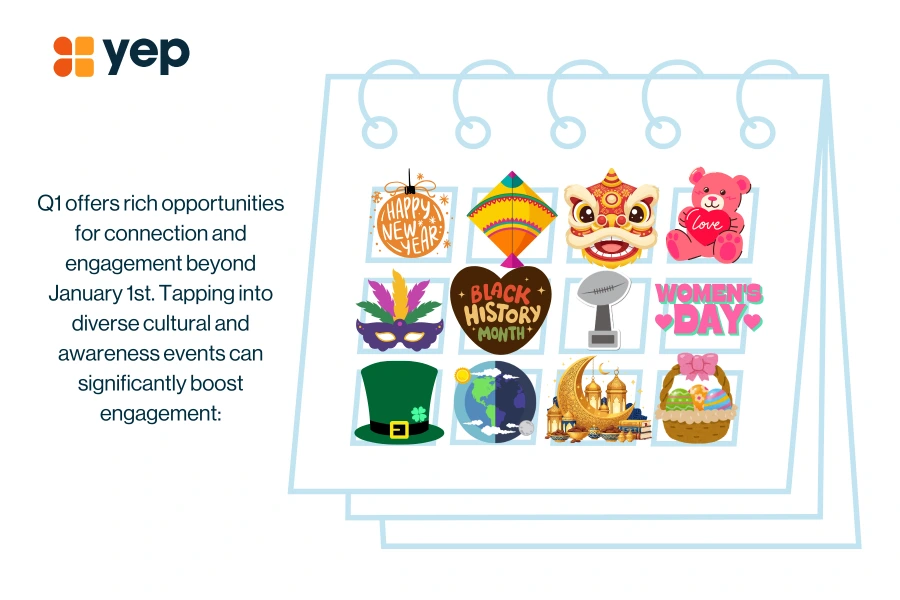
2. Plan Q1 Around Cultural Moments
Q1 offers rich opportunities for connection and engagement beyond January 1st. Tapping into diverse cultural and awareness events can significantly boost engagement:
Valentine’s/Galentine’s Day (February): Focus on connection, self-care, and building community bonds.
Campaign Idea: Run a “Share the Love” Referral Challenge: Enthusiastically reward customers who refer a friend with an exclusive self-care product bundle.
Black History Month (All of February): Focus on Inclusivity & Education.
Campaign Idea: Feature the stories and voices of Black creators or entrepreneurs who use your product/service, showing support for diversity within your community.
Lunar New Year (Varies): Focus on cultural appreciation, prosperity, and celebratory themes.
Campaign Idea: Launch a Special Limited-Time Offer bundle tied to themes of abundance and success for the year ahead, tailored to customers in relevant regions.
Super Bowl / March Madness (Feb/March): Focus on communal viewing, entertainment, and easy hosting solutions.
Campaign Idea: Promote products perfect for gathering, or run a themed social media competition for game-day predictions to drive fast engagement.
International Women’s Day (March 8): Focus on Empowerment & Values.
Campaign Idea: Celebrate female employees or customers. Commit to donating a percentage of sales on March 8th to a recognized women’s organization.
Spring Equinox (Mid to Late March): Focus on Cleaning, Organization, and Renewal.
Campaign Idea: Run a “Digital Declutter” promotion for organization tools or services, perfectly aligning with the popular idea of Spring Cleaning.

3. Activate User Generated Content (UGC): The Power of Authenticity
The holiday gifting period is a treasure trove of fresh UGC. Actively encourage customers to share unboxing videos or photos of their new gifts in use. This highly authentic content instantly generates trust and serves as incredibly effective, organic social proof for Q1 retargeting campaigns.
Budget Smarter: Start Investing to Win with High-ROI
Q1 requires financial discipline. Structure your budget to confidently prove ROI, adopting the mindset of a strategic investor ready to capture market share.
1. Implement the Fixed vs. Flexible Budget Rule
Divide your spend to maintain stability while saving the necessary resources for fast scaling and testing.
- Fixed Spend (60–70%): Dedicated to proven, high ROI baseline channels (e.g., SEO, Email Marketing, consistent retargeting, core content production).
- Flexible Spend (30–40%): Designated as a strategic reserve for testing new campaigns and, most importantly, for immediately scaling mid quarter campaigns that show strong early promise.
Actionable Tip: If a specific goals themed ad campaign achieves fantastic early performance in January, having flexible funds ready allows you to double down instantly, utilizing market opportunity without waiting for scheduled budget reviews.
2. Power Growth Through Owned Media and Data Driven Paid Ads
With third party tracking diminishing, your owned channels are your most dependable, high potential assets.
- Double Down on Email and SEO: These channels consistently deliver the highest long term ROI. Update high-ranking content with fresh 2026 insights and strong Calls to Action (CTAs). Use your clean First-Party Data to create advanced, hyper-personalized email flows.
- High-Intent Retargeting: Allocate a significant paid media budget to retarget site visitors who engaged in Q4 but did not convert. These are warm, valuable leads and are substantially cheaper to convert than cold audiences.
- Allocate for Analytics and Tools: Invest wisely by dedicating 5-10% of the budget specifically to measurement platforms, A/B testing tools, and data optimization infrastructure. This commitment is what validates your ROI and informs a smarter strategy for the rest of the year.
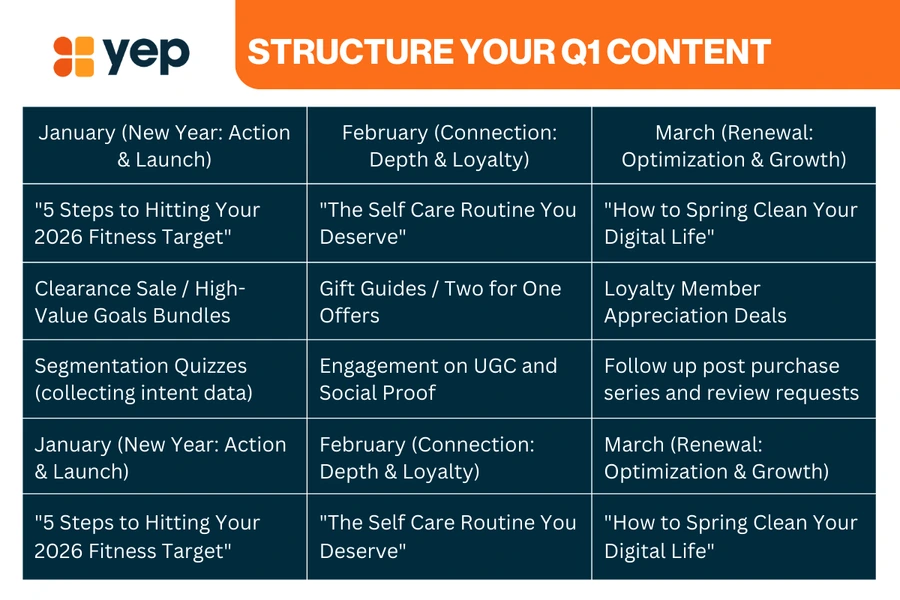
Map Out Your 90 Day Content Matrix: Consistent Messaging Drives Results
Structure your Q1 content (blogs, social posts, emails) into a clear, thematic matrix for consistent, impactful messaging:
Final Thoughts
When you plan Q1 with this much strategy and positive energy, your business is guaranteed to move smoothly from the intense holidays right into a period of focused, profitable growth and strong momentum.
Your Q1 Strategy FAQs
Why is December the best time to plan Q1?
December provides a strategic pause where transactional volume slows down compared to Black Friday/Cyber Monday. This is the ideal, less pressured time to perform a detailed audit of your Q4 results and get your foundational data clean before the New Year rush begins.
What is the most important data point to check in December?
Year over Year (YoY) and Quarter over Quarter (QoQ) Growth Rates are critical. Comparing Q4 to previous quarters helps you determine if a good result was a true win or just a predictable seasonal spike, allowing you to invest in the right channels in Q1.
How should I handle returns and gift card use in January?
Treat them as prime customer service opportunities. Ensure the returns process is easy to build trust. For gift cards, run dedicated mid January campaigns to boost usage and drive upsells (“Redeem your $50 card and get free shipping!”) to capture extra revenue.
What is the Fixed vs. Flexible Budget Rule?
This strategy recommends allocating 60-70% of your Q1 budget to proven, stable channels (Fixed Spend) and setting aside 30-40% as a strategic reserve (Flexible Spend). This allows you to immediately double down on any new campaign that shows fantastic early ROI, maximizing your advantage.
Share