
Life Insurance Leads: How to Generate Leads That Actually Convert
Life insurance is one of those things people usually think about for a reason.
Maybe life has changed. Maybe responsibilities have grown. Maybe someone is simply getting more serious about planning ahead.
Whatever brings them there, people looking into life insurance are rarely just casually browsing. There is usually a real question behind the search.
That is what makes life insurance leads so interesting from a marketing perspective. The goal is not simply to collect more names and phone numbers. It is to understand what someone is looking for, meet them at the right point in that journey, and do our best to make the next steps feel clear and useful.
And there is plenty of interest out there. LIMRA reported that U.S. individual life insurance policy sales grew 8% year over year in Q2 2026.
So the real question is not just trying to maximize the amount of leads you can get.
It is how to generate leads that actually make sense for the person behind them.
Key Takeaways
- A strong life insurance lead is about more than volume. Intent, fit, accuracy, consent, and timing all help determine lead quality.
- The funnel shapes the result. Targeting, ad messaging, landing pages, and form questions all influence who becomes a lead.
- CPL only tells part of the story. Contact rate, qualification rate, quote rate, and cost per acquisition help show what happens next.
- Different traffic sources can signal different levels of intent. Search, social, native, affiliates, and calls all play different roles in the customer journey.
- The best campaigns keep learning from downstream results. Understanding which leads actually move toward a quote or sale makes optimization much more useful.
What Are Life Insurance Leads?
A life insurance lead is someone who has shown interest in life insurance and provided information that can connect them with an insurer, broker, agent, or advertiser.
But not every lead is showing the same level of interest.
Someone reading an insurance article might be casually exploring, while another is comparing policies is a step closer towards a result.
Someone filling out a quote form and asking to speak with someone? That is a much stronger signal.
That is why a good lead generation strategy looks beyond the form fill itself and sparks the beginning of a journey.
What Makes a Good Life Insurance Lead?
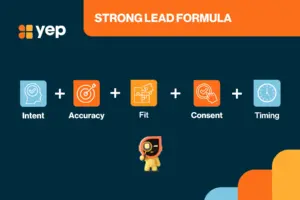
Source: Yep Illustrated Infographic
There is no magical formula, but five things matter a lot:
Intent
Did the person genuinely show interest in life insurance?
Accuracy
Is their contact information valid?
Fit
Do they match the campaign, product, geography, or qualification criteria?
Consent
Do they understand what they are signing up for and how they may be contacted?
Timing
Can the lead reach the right advertiser while that interest is still fresh?
Put those together and you get a much better picture than simply saying:
“We generated 500 leads today.”
Great.
What kind?
Where Do Life Insurance Leads Come From?
Life insurance leads can come from paid search, social ads, native advertising, affiliate marketing, content, comparison funnels, email, or inbound calls.
Each one can tell you something different about intent.
Search, for example, can capture people already looking for answers. Someone searching “term life insurance quote” is giving you a very clear clue about what they want.
Yep’s guide to Google Ads for lead generation highlights how keyword intent, landing pages, tracking, and lead quality all work together.
Social and native can reach people earlier in the journey, while affiliate partners can connect advertisers with audiences through content, paid media, comparison experiences, and other approved traffic sources.
While you may be navigating through each channel to decide which one, the important thing to keep noted is what the person plans to do next.
Why the Funnel Matters
The form might be where the conversion gets recorded, but the lead starts taking shape much earlier. The ad sets the expectation, the targeting determines who sees it, and the landing page has to make the offer clear enough for someone to decide whether it is relevant to them.
That matters even more with life insurance, where people can be unsure about products, pricing, or how much coverage they actually need.
LIMRA’s consumer research continues to show that confusion, instead of lack of interest, around life insurance is a major factor that is holding people back from taking the next step.
A stronger funnel does not necessarily need more steps or more targeting. Sometimes the biggest improvement comes from making the experience easier to understand, setting clearer expectations, and asking the right questions at the right time.
Measure More Than CPL
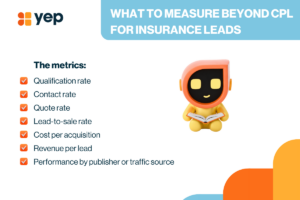
Source: Yep Illustrated Infographic
Cost per lead is useful, but it can only tell you so much on its own.
Imagine Campaign A is generating leads at $30 each, while Campaign B is coming in at $45. Campaign A looks better at first glance, but if Campaign B is producing a higher percentage of qualified prospects and more customers, the cheaper lead is not necessarily the better deal.
That is why advertisers often need to look beyond CPL and pay attention to metrics such as:
- Qualification rate
- Contact rate
- Quote rate
- Lead-to-sale rate
- Cost per acquisition
- Revenue per lead
- Performance by publisher or traffic source
Yep’s tracking and reporting approach helps connect those downstream results back to the traffic, partners, and campaigns that generated them.
While it is great to have a lower price of each lead, you should really understand which leads are actually contributing to stronger campaign performance.
How Yep Approaches Lead Generation
At Yep, lead generation is approached as a full performance process instead of a single point of conversion.
That process includes looking at how audiences are reached, which traffic sources and affiliates are contributing quality prospects, how creatives and landing pages are performing, and what follows after a lead enters the funnel.
Yep’s lead generation and management services focus on attracting relevant prospects, monitoring lead quality, and optimizing campaigns based on the results that matter farther down the customer journey.
When patterns start appearing, campaigns can be adjusted around the audiences, sources, and experiences that are producing stronger outcomes.
Turn Better Traffic Into Better Leads
People look into life insurance for all kinds of reasons. Maybe it follows a major life change or maybe it is just simply trying to be more financially organized.
For marketers, the goal is to be able to meet that interest with clear experience that helps the right person move naturally toward the next step.
If you are looking to scale life insurance or another lead-generation campaign, Yep works with advertisers across performance media, targeting, affiliate partnerships, creative, and optimization to help turn strong traffic into stronger customer acquisition.
Frequently Asked Questions
What are life insurance leads?
Life insurance leads are prospective customers who have shown interest in life insurance and provided information that can connect them with an insurer, broker, agent, or advertiser.
How do you generate life insurance leads?
Life insurance leads can come from paid search, social and native advertising, affiliate marketing, content, comparison funnels, email, or inbound calls.
How much do life insurance leads cost?
Costs vary depending on traffic source, geography, product, targeting, exclusivity, competition, and lead quality. CPL should always be considered alongside downstream conversion performance.
Are exclusive life insurance leads better?
Exclusive leads can reduce competition for the same prospect, but exclusivity alone does not guarantee strong intent or lead quality.
What makes a life insurance lead high quality?
Strong leads usually combine genuine intent, accurate information, a good fit for the offer, clear consent, and timely follow-up.
You Might Also Like
Share
