
Affiliate Marketing Statistics Shaping 2026 & 2027
Affiliate marketing is getting bigger, but the more interesting story is how much broader the channel has become. Here are the numbers worth watching.
What does affiliate marketing look like in 2026? Around 60% of respondents in the Performance Marketing Association’s 2026 U.S. Brand Survey said they are intentionally prioritizing content partnerships designed to influence AI-generated search results and Large Language Models. At the same time, brands are putting more attention toward creators, content partners, technology solutions, and a broader mix of performance relationships.
Affiliate marketing statistics have a funny habit of sticking around.
You find a number in a 2026 article, follow the source, and suddenly you are looking at research from three years ago that has been quoted 47 times since.
So rather than give you a giant list of numbers with questionable birthdays, we looked for the ones that actually help explain affiliate marketing right now.
And there is plenty happening. Creators are becoming performance partners, brands are testing new ways to measure influence, shoppers are using more places to research products, and AI is entering both sides of the equation.
Here are the numbers that matter heading into 2027.
Основные выводы
- Around 60% of respondents in PMA’s 2026 Brand Survey are prioritizing content partnerships designed to influence AI search and Large Language Models (LLMs).
- Influencer and blogger representation in Awin’s 2026 Power 100 has increased 180% compared with its previous index.
- 54% of U.S. advertising decision-makers surveyed in IAB’s September 2026 outlook are increasing their focus on creator and influencer partnerships.
- Nearly 80% of respondents in PMA’s 2026 affiliate survey findings still use last-click attribution, leaving plenty of room for measurement to evolve.
- According to PMA’s U.S. affiliate marketing study, affiliate spend reached $13.62 billion, generating $113 billion in ecommerce sales in 2024.
The Affiliate Mix Is Getting Much Bigger
The old picture of affiliate marketing was fairly easy to draw: brand, publisher, tracked link, sale.
That picture still works. You just need a much bigger piece of paper.
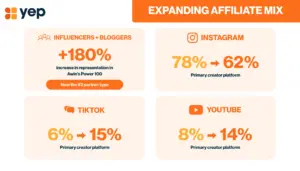
Awin compared its 2026 Power 100 partner index with its previous edition and found that influencer and blogger representation had climbed 180%. Influencers are now the second-most common partner type on the list, behind coupon and cashback partners combined.
Creator habits are changing too. Awin’s creator platform data shows Instagram still leads, but its share as creators’ primary platform dropped from 78% in 2024 to 62% in 2026. TikTok increased from 6% to 15%, while YouTube moved from 8% to 14%.
That is useful for brands because an affiliate strategy no longer has to depend on one type of partner or one way of reaching people.
Content sites, creators, loyalty partners, technology partners, shopping platforms, paid media affiliates and other models can all play different roles.
You can see that variety in our recent look at affiliate marketing examples, where the same basic performance model works very differently across retailers, creators, content and paid media.
Creators Are Looking More Like Performance Partners
Creator marketing and affiliate marketing used to have a pretty obvious dividing line.
One was about reach and awareness. The other was about clicks and conversions.
That line is getting harder to see.
According to IAB’s 2026 CreatorFronts research, U.S. creator advertising is expected to reach about $44 billion in 2026, more than triple its 2021 level and growing nearly four times faster than the wider media industry.
The performance side is showing up clearly too. In IAB’s September 2026 advertising outlook, 54% of surveyed brand and agency decision-makers said they were increasing their focus on creator and influencer advertising or partnerships.
Awin’s Q3 influencer analysis adds another layer. Creators are increasingly spreading links across several programs and platforms rather than depending on one source of affiliate income. Awin describes creators as behaving more like independent commerce businesses, choosing partners based on things such as rates, data and reliability.
That opens up a pretty fun opportunity for brands.
A creator does not need to be treated as awareness on Monday and affiliate on Tuesday. Content, trust and tracked performance can increasingly live in the same partnership.
Shoppers Are Taking Their Time
The person clicking an affiliate link probably did not materialize five seconds earlier with their credit card already in hand.
People compare. They watch. They open another tab. They come back later.
Impact.com and Cardlytics’ 2026 Consumer Spending Intelligence Report gives us a good look at that behaviour. The research combines affiliate activity across 2,368 North American retail brands with purchasing intelligence representing roughly 195 million U.S. cardholders.
The same report found that affiliate click volume increased 2% year over year while conversion rates fell 6%. At the same time, average commission rates climbed 2% and non-action-based partner payments grew 3%.
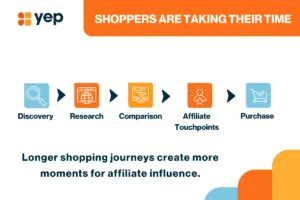
That does not mean shoppers disappeared. The research points to more consideration happening between discovery and purchase, with longer journeys and more touchpoints.
For affiliate marketers, that creates more room to influence the research phase with reviews, comparisons, social content, shopping tools and niche expertise.
Finding the right audience becomes even more useful here. Our guide to profitable affiliate niches looks at where different kinds of purchase intent can create opportunities.
AI Just Joined the Shopping Journey
Here is where 2026 gets particularly interesting.
PMA’s 2026 U.S. Brand Survey found that around 60% of respondents are intentionally prioritizing content partnerships designed to influence AI-generated search results and Large Language Models.
That is a pretty big shift for something that was barely part of most affiliate strategy conversations a few years ago.
It lines up with what is happening across advertising more broadly. IAB’s September outlook found that advertisers are responding to product discovery spreading across traditional search, social, commerce platforms and conversational AI. Alongside creators, 48% of respondents said they were increasing their focus on publishers with first-party data and 45% on contextual advertising.
For affiliates, this makes useful, specific content even more interesting. Product comparisons, expert explanations, reviews and niche recommendations can potentially influence discovery across search, social and AI-driven environments.
For brands, it means thinking about who talks about your products, not only where your ads appear.
Tracking Has More Catching Up to Do
There is one slightly funny part of all this.
The customer journey keeps gaining more touchpoints, while a lot of measurement still asks, “Okay, but who clicked last?”
PMA’s 2026 Brand Survey results found that almost 80% of respondents still use last-click attribution, even as programs spend more on content, influencers and creators higher in the funnel.
There are signs that brands want to look further. In impact.com’s State of Affiliate Marketing research, 94% of surveyed brands were experimenting with or planning to adopt alternative attribution models within the following year. The study surveyed 818 marketers, 284 publishers and 421 creators across eight countries in mid-2025.
Those numbers come from different studies and time periods, so they should not be treated as a direct comparison. Together, though, they show why attribution remains such an active area.
If a creator introduces the product, a review answers the shopper’s questions and a cashback partner gets the final click, giving all the credit to one touchpoint leaves part of the story out.
Good affiliate tracking gives you the data. The next step is getting better at understanding what each partner actually contributed.
What Q3 2026 Is Telling Us About 2027
We are not going to pretend we found a crystal ball in the office.
But late-2026 data gives us a few useful clues.
Creator Affiliate Partnerships Will Keep Expanding
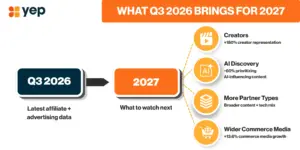
Awin’s 2026 partner data shows creator representation up 180% compared with its previous Power 100, while IAB’s latest advertiser research found 54% of decision-makers increasing their focus on creators and influencers.
That combination makes creator affiliate relationships one of the clearest areas to watch in 2027.
AI Visibility Will Become Part of Affiliate Strategy
With roughly 60% of respondents in PMA’s 2026 survey already prioritizing content that can influence AI-generated discovery, AI visibility is moving into actual partnership planning.
The next question is measurement. Brands will want to know whether those partnerships influence discovery, consideration and eventually sales.
Brands Will Use More Types of Partners
PMA’s latest brand survey findings show investment moving more heavily toward content, influencer and creator partnerships while technology solutions continue to grow.
Rather than one “best” affiliate model winning, 2027 looks more likely to reward programs that can combine several of them.
Commerce Will Spread Across More Places
IAB’s revised 2026 forecast projects 13.6% year-over-year growth in commerce media, while Awin’s Q3 retail media analysis highlights retailers extending investment beyond their own websites through affiliate content, creator environments and other performance-driven partnerships.
The store is no longer always where product discovery starts.
What This Means for Brands and Affiliates
For brands, the opportunity is variety.
You can build around content, creators, technology, loyalty, paid media and other partners rather than expecting one channel to do every job. Better tracking also gives you more room to understand where those partners actually add value.
For affiliates, the same shift means more ways to build a business. A publisher can combine search content with email. A creator can use social, video and affiliate links. A media buyer can test multiple traffic sources. Expertise can live across more than one channel.
At Yep Ads, that is a big part of how we look at performance marketing. Brands need partners capable of reaching the right audiences, while affiliates need offers, tracking and campaign support that fit the traffic they actually generate.
The ecosystem is getting bigger, but more importantly, it is giving everyone more ways to play.
Часто задаваемые вопросы
How big is the affiliate marketing industry in 2026?
The latest comprehensive U.S. industry study from the PMA found affiliate marketing spend reached $13.62 billion in 2024, generating $113 billion in ecommerce sales. More recent 2026 research points to continued expansion across creators, technology partners, content and AI-focused strategies.
Is affiliate marketing still growing?
Yes. PMA’s industry research found U.S. affiliate spend increased 49.8% between 2021 and 2024, while newer 2026 research shows brands continuing to explore a wider mix of affiliate partners and strategies.
Are creators considered affiliates?
They can be. A creator becomes part of an affiliate model when their activity is tied to trackable actions such as clicks, sales or leads. Many modern creator partnerships also combine affiliate commission with fixed fees or other compensation.
How is AI affecting affiliate marketing?
AI is affecting content creation, product discovery and campaign strategy. In PMA’s 2026 survey, around 60% of respondents said they were prioritizing content partnerships intended to influence AI-generated search results and LLMs.
What affiliate marketing trends should we watch in 2027?
Creator commerce, AI-driven product discovery, broader partner mixes, commerce media and more advanced attribution are among the strongest areas to watch based on recent research from PMA, IAB и Awin.
Заключительные размышления
The best affiliate marketing statistics in 2026 are not really telling us one story about growth. They are showing us how much more affiliate marketing can now include.
Creators are selling. Content is influencing AI discovery. Technology partners are growing. Brands are looking beyond a single click, and shoppers have more ways than ever to find the products they eventually buy.
That gives brands more ways to reach customers and affiliates more ways to build something worth clicking.
For brands: Explore Yep’s advertiser solutions and see how performance partnerships can support your acquisition strategy.
For affiliates: Join the Yep publisher network to explore campaigns that fit your traffic and audience.
Вам также может понравиться
Поделиться
