Native Advertising Examples: 7 Ideas Marketers Can Learn From
Most ads have to fight for attention. Native ads play on a whole different level.
Instead of sitting off to the side, they meet people where they are already scrolling, reading, shopping, or exploring. When done well, they feel less like an interruption and more like part of the experience.
At Yep, we work with advertisers and publishers running native traffic every day, so we see where it is actually performing. Lately, our publisher managers have seen especially strong results across Health & Wellness, E-Commerce, and Finance.
But strong native advertising is about more than matching a website’s font or colors. The best native advertising examples understand the environment, what the user is doing, and what could make them want to keep going.
So rather than looking at the nicest-looking ads, we’re focusing on what marketers can actually learn from them.
Key Takeaways
- Native ads work best when they fit what people are already doing on the platform.
- Creative should adapt to the environment instead of being recycled across every channel.
- The landing experience should feel connected to the ad that brought someone there.
- The best examples give marketers ideas to test rather than layouts to copy.
What Makes a Native Ad Worth Learning From?
Native advertising is sometimes reduced to “an ad that looks like the content around it,” but that misses the mark on what really is happening to make the format interesting.
Strong native campaigns tend to get several things working together:
- Context: The placement makes sense for what the person is already doing.
- Creative: The headline, image, or video suits the platform.
- Value: There is a real reason to click, watch, or read.
- Continuity: The next page follows through on the idea that earned the click.
- Transparency: Paid content remains recognizable as advertising.
- Performance: The campaign is ultimately tied to a measurable result.
If you want a broader explanation of the channel itself, Yep’s guide to native advertising goes deeper into how native traffic can fit into a performance strategy.
Native Advertising Examples Marketers Can Learn From
1. Adobe on Reddit: Read the Room
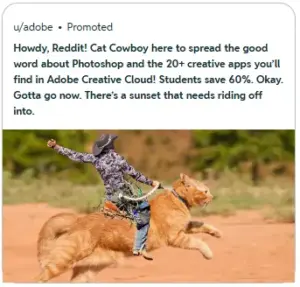
Source: Adobe Native Ads On Reddit
Reddit has a culture of its own. People are there for conversations, recommendations, opinions, niche communities, and the occasional thread that somehow turns into a two-hour rabbit hole.
That makes it a tricky place for creative that feels overly polished or obviously transplanted from another campaign.
Adobe worked with Reddit’s KarmaLab to create Promoted Posts specifically for the platform and its design-focused audience. According to Reddit’s own case study, the Reddit-built Promoted Posts delivered a 40% higher click-through rate than Adobe’s standard creative.
The takeaway is bigger than “make Reddit-looking ads.” Adobe treated the platform as part of the creative brief instead of just another place to upload an asset.
What marketers can borrow
Before moving creative from one channel to another, spend some time looking at what people actually engage with there.
Reddit audiences can also be quick to reject creative that feels out of place, which makes understanding the community especially important.
This really highlights the need for understanding the environment you are putting content that no one asked for in, so proceed with intentionality.
2. Heist on Pinterest: Join the Discovery Process

Source: Heist On Pinterest
Pinterest catches people while they are already looking for ideas. They might be planning a purchase, comparing styles, saving products for later, or figuring out what they want before they even know exactly what to search for.
That was a natural fit for fashion brand Heist.
When the company expanded into shapewear, it used Promoted Pins and keyword targeting to reach people searching for topics such as tights, shapewear, and women’s fashion. Pinterest reports that the campaign contributed to customer acquisition while reducing Heist’s cost per acquisition by 78%.
The product was appearing during a moment when people were already open to discovering something new.
What marketers can borrow
Think beyond who you want to reach and look at what that person is doing when your ad arrives.
A user looking at outfit ideas has a different mindset in mind from someone checking their work messages. Even if both fit your demographic targeting, the same creative probably should not greet them both.
Context can do a surprising amount of the heavy lifting.
3. Amazon Sponsored Products: Work With Existing Intent
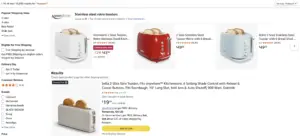
Source: Amazon Search
Amazon Sponsored Products appear in shopping results and on product detail pages, putting them right inside the comparison process. Amazon describes them as cost-per-click ads for individual products that can lead shoppers directly to the advertised product page.
By the time somebody is searching for a specific product category, a lot of the warming up has already happened.
They may already have in their mind what they need, they are now comparing prices, features, ratings, photos, and whether paying an extra $30 is actually going to change their life.
What marketers can borrow
The closer someone gets to a decision, the more useful clear comparison points become.
At this stage, strong product imagery, reviews, pricing, and a clear differentiator may do far more work than a big awareness message. A convincing negative review can sometimes outweigh several positive buying signals, which is another reason reputation and social proof matter so much near the point of purchase
It is also a good example of why media buying strategy should consider where the audience is in the buying journey, rather than treating every impression the same way.
4. LinkedIn Sponsored Content: Work With the Professional Mindset
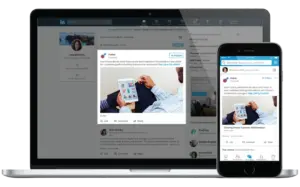
Source: LinkedIn Single Job Ads
LinkedIn Sponsored Content appears directly inside the feed, alongside industry discussions, company updates, career news, thought leadership, case studies, and professional advice.
LinkedIn also offers Direct Sponsored Content, which lets marketers personalize and test native ads for specific audiences without publishing each variation on the company’s LinkedIn Page.
That gives you plenty of room to adjust the message based on the person seeing it.
A marketing director and a finance lead might both influence the same purchase, but they probably do not care about exactly the same part of your pitch.
What marketers can borrow
Use the environment to help decide what the opening message should be.
On LinkedIn, a useful benchmark, research finding, case study, or practical resource can feel much more at home than an ad that immediately jumps to “Book a Demo.”
The conversion can come later. First, the creative has to earn a few seconds in a feed full of work-related content.
5. TikTok Spark Ads: Look at What Already Has Momentum
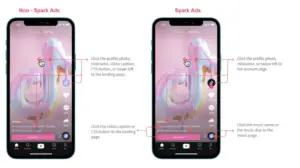
Source: TikTok Spark Ads
TikTok Spark Ads give marketers an interesting head start: the ad creative can come from an existing organic TikTok post.
TikTok currently describes Spark Ads as a native format that can use posts from a brand’s own account or content from other creators with authorization. Engagement generated while the post is promoted, including likes, comments, shares, and follows, stays connected to the organic post.
That means your paid creative process does not always have to begin with a blank storyboard.
Sometimes the audience has already started telling you what is interesting.
What marketers can borrow
Use organic content as a creative testing ground. The environment of TikTok allows for virality from even the simplest of videos.
A tutorial may unexpectedly outperform the polished brand video. A creator comparison might generate more questions than the product demo. A five-second moment from a longer video could become the hook everyone remembers.
Those signals do not guarantee paid performance, but they can give you a much better starting point than guessing what “TikTok-style” advertising is supposed to look like.
6. Taboola: Make the Next Click Worthwhile
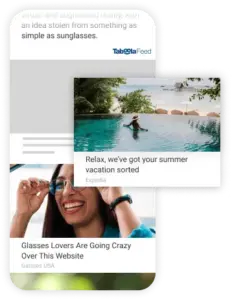
Source: Taboola Native Advertising
You’ve probably seen those recommended articles sitting underneath a news story. Some look genuinely interesting. Others make you wonder how they ended up there.
That’s the space where Taboola operates, placing sponsored recommendations alongside publisher content to encourage readers to explore something new.
Unlike search advertising, where someone is actively looking for an answer, recommendation widgets often reach people who are simply browsing. That means the headline and creative need to give readers a compelling reason to click.
What marketers can borrow
Think about what would genuinely interest someone enough to open another article.
A cybersecurity campaign might highlight a warning sign people often miss. A home-services campaign could introduce a common household problem. A software campaign might lead with a frustrating everyday task.
The important part is delivering on that curiosity. If the headline promises useful information, the landing page needs to provide it.
7. Sponsored Editorial Content: Give People Something for Their Time
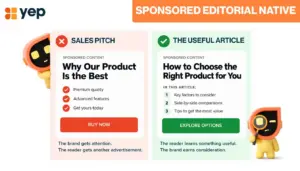
Source: Yep Illustrated Infographic
Sponsored articles give marketers something most ad formats are short on: space.
You can explain the problem properly, compare options, answer questions, introduce research, or help someone understand a category before asking them to take the next step.
Unfortunately, more space also means more room to write a very long sales brochure.
Readers tend to figure that out fairly quickly.
What marketers can borrow
Start with the reason somebody would want to read the article in the first place.
If the topic promises a buying guide, make it useful as a buying guide. If it promises an explanation, explain the thing. The brand can enter naturally where it actually helps the reader.
Yep’s approach to content marketing follows a similar principle: useful content can move someone further through the funnel before the hard conversion ask appears.
There is also an important transparency piece here. The Federal Trade Commission says native advertising should not mislead consumers about its commercial nature. When disclosure is necessary, it should be clear and prominent, particularly when paid content closely resembles the surrounding editorial material.
You want the content to fit the publication. You do not want readers wondering who actually paid for it.
What These Native Advertising Examples Have in Common
Put these examples next to each other and they barely look like the same type of advertising.
That is part of the point.
Good native advertising changes with the environment, but a few habits keep showing up.
They Fit the Situation
Adobe built for Reddit. Heist joined a discovery experience on Pinterest. Amazon Sponsored Products show up when somebody is already comparing what to buy.
The placement tells you something about the person before you even get into audience targeting.
Use that information.
They Adjust to the User’s Mindset
Someone saving ideas for later probably needs a different message from someone with three nearly identical products open and a credit card nearby.
This is where native campaigns can get lazy. The same creative gets resized, cropped, uploaded everywhere, and suddenly the “multi-channel strategy” is mostly a collection of aspect ratios.
The core campaign can stay consistent without every placement saying the exact same thing.
They Keep the Journey Connected
The click is not the finish line.
If someone opens an ad because you promised to explain a problem, the next page should probably explain that problem before asking them to buy something.
Creative, landing page, audience, offer, and conversion data all need to be looked at together, which is where ongoing campaign optimization becomes much more useful than chasing a higher click-through rate on its own.
They Give You Plenty to Test
Native campaigns come with no shortage of knobs to turn: headline, visual, audience, placement, angle, landing page, offer, and call to action.
Resist the urge to turn all of them at once.
If you change the headline, image, landing page, audience, and offer together, congratulations, something changed. You just have very little idea which part did the work.
Test deliberately and let each round teach you something.
Don’t Copy the Ad. Copy the Thinking.
Competitor research can be genuinely useful, especially when it helps you spot an idea you had not considered.
The trouble starts when the research ends at the screenshot.
Before recreating an ad, look at everything around it. What was the user doing when they saw it? How aware were they already? Why did that particular angle fit the platform? What happened after the click?
Sometimes the most useful part of an ad has almost nothing to do with how it looks.
Maybe it is the comparison angle. Maybe the advertiser introduced the problem before the product. Maybe creator content made the offer easier to understand. Maybe the landing page continued the exact same story.
That is the part worth borrowing.
Where Yep Ads Fits
Native advertising can look simple when all you see is the finished ad. Behind it are traffic sources, placements, audiences, creative, content, tracking, landing pages, offers, and a lot of small decisions that can change performance.
Yep Ads works across native and other performance channels, helping brands and affiliates connect those pieces and focus on the combinations that are actually producing results.
For brands running several acquisition channels at once, multi-channel marketing can also help native work alongside search, social, and other paid channels rather than asking one format to carry the entire strategy.
Native Advertising Mistakes to Avoid
Most native mistakes are not particularly mysterious. They usually come from treating the placement as an afterthought.
Watch out for:
- Using the same creative across every platform without adapting it.
- Copying an ad without understanding why it worked in that environment.
- Sending people to a landing page that barely resembles what they clicked.
- Judging success entirely by click-through rate.
- Turning sponsored content into an unnecessarily long product pitch.
- Making it unclear that paid content is advertising.
Native works best when the ad feels comfortable in its surroundings without pretending to be something it is not.
Frequently Asked Questions
What is an example of native advertising?
A sponsored post appearing inside a social feed is a common example. Native advertising can also include sponsored articles, recommendation widgets, promoted product listings, native video, and other paid placements designed around the normal experience of the platform where they appear.
What are the main types of native ads?
Common formats include in-feed ads, sponsored editorial content, recommendation units, promoted product or search listings, social media ads, and native video. The exact format changes depending on the platform, which is why native creative usually needs to be adapted to its environment.
How do you make native advertising effective?
Start with what the audience is doing when they see the ad. Match the creative and message to that moment, keep the post-click experience consistent, and measure the conversions that matter to the campaign rather than focusing on clicks alone.
Final Thoughts
The interesting thing about native advertising examples is how little some of them have in common visually.
An Amazon product listing, Reddit post, TikTok video, and sponsored article can all approach native advertising in completely different ways because they are meeting people in completely different moments.
That is what is worth paying attention to.
When you find an example you like, look beyond the headline and creative. Figure out why it belonged where it appeared, what made the next step attractive, and which part of that thinking makes sense for your own campaign.
For brands: Explore Yep Ads’ advertiser solutions if you’re looking to test or scale native traffic.
For affiliates and publishers: Join the Yep Ads publisher network to explore available offers and opportunities.
You Might Also Like
Share
