
What Is an Affiliate Network?
An affiliate network is an online platform that sits between advertisers and publishers. The advertiser chooses what it will pay for a given result and how much. Publishers promote that product or service to their audience. When someone buys or signs up, the network pays the publisher a commission.
Advertisers use affiliate networks to reach people they could not reach on their own. Publishers use them to earn money from an audience they already have, by recommending products those readers are likely to want.
The model works because neither side gets paid unless the other one does. The advertiser only pays when a sale or lead comes through, and the publisher only earns when it delivers one.
Yep Ads is a A global performance marketing agency that helps advertisers and publishers grow through measurable digital marketing campaigns. Yep Ads is focused on performance-based customer acquisition, traffic solutions, campaign optimization, and advertiser/publisher partnerships.
Key takeaways
- An affiliate network is a shared marketplace and tracking layer connecting advertisers who want customers with publishers who have audiences.
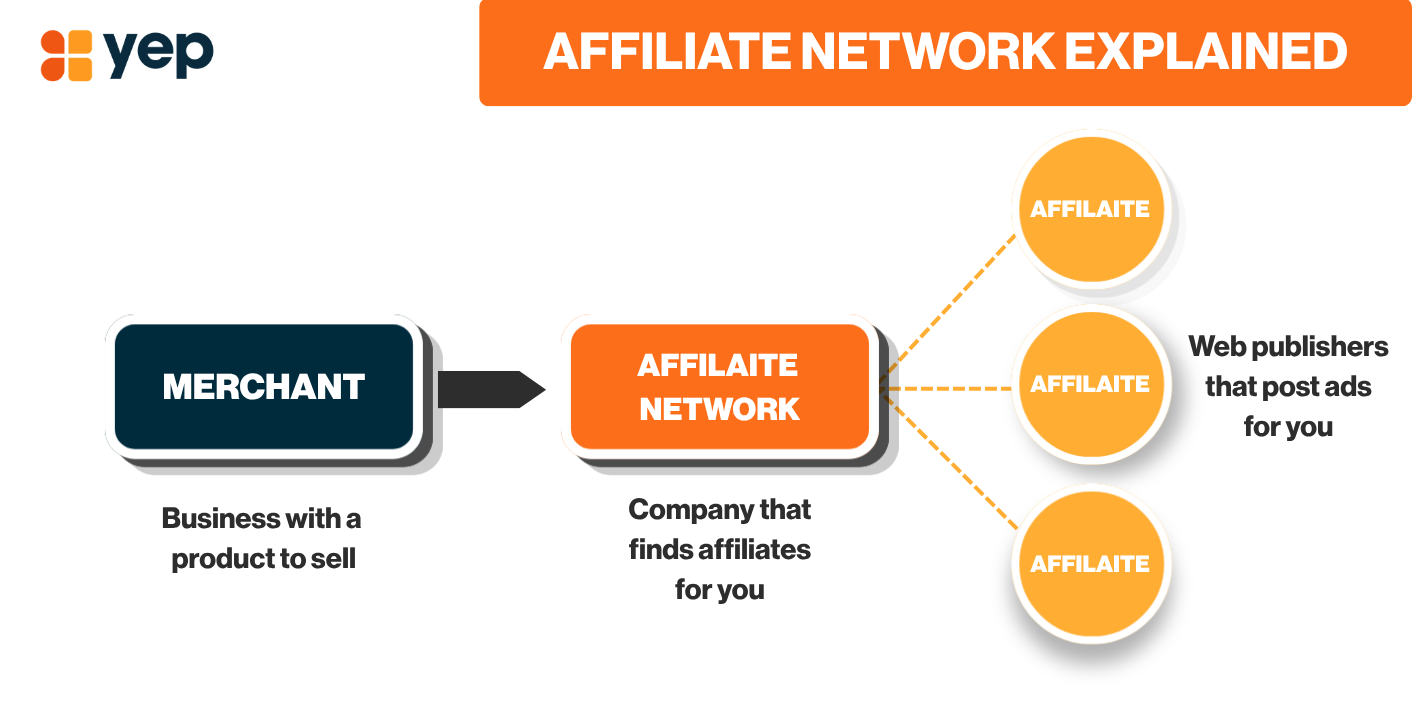
- Three parties are involved: the advertiser funding the offer, the publisher promoting it, and the network running the plumbing.
- Advertisers pay on a defined result, not impressions or clicks, which pushes most of the media risk onto the publisher.
- The most overlooked function is not introductions. It is attribution, validation, fraud control and paying partners on schedule.
- Fit depends on scale, category and margin. Plenty of advertisers do better with a few direct partnerships.
The three parties in an affiliate network
Source: Yepads
The advertiser
The brand pays for results. It sets the offer, the payout and the action that counts as a conversion, and it supplies the creative.
The publisher, or affiliate
The site, creator or media buyer sending the traffic. Its value is an audience already looking to buy, which is worth far more than raw volume.
The network
The layer in the middle. It runs the tracking, recruits and vets partners, polices compliance, and moves the money, paying the publisher before the advertiser has settled. It takes a cut of every payout. Its risk is unpaid invoices and fraud it fails to spot.
How affiliate networks work, step by step
This is the part most explainers skip, and it decides whether a program is worth running.
- Offer setup. The advertiser defines the conversion event, payout, permitted geographies and traffic sources, the attribution window, and anything banned outright such as brand bidding.
- Publisher approval. The network reviews what applicants publish and where their traffic comes from. Programs that auto-approve everyone are where fraud enters.
- Tracking integration. The publisher gets a link carrying a unique click ID, which the advertiser stores and returns via postback: a server-to-server call reporting the conversion.
- Click and attribution. The attribution window, the period a click stays eligible for credit, commonly runs from 24 hours to 30 days. Last click remains the default, because it is cheap to arbitrate.
- Conversion fires. The advertiser’s server posts the click ID back with the order value or lead detail.
- Validation. Conversions sit pending while returns, chargebacks and unusable leads are stripped out. Thirty to sixty days is common.
- Invoicing and payout. Approved conversions are billed to the advertiser and the publisher is paid on a stated schedule, net 15 to net 60 being common. Later reversals are clawed back.
Benefits of affiliate networks
Networks earn their place on both sides of the marketplace, but for different reasons. For advertisers, the main benefits are:
Pay only for results — Budget goes out when a sale, lead or install actually happens, so the financial risk of testing a new channel sits mostly with the partner rather than the brand.
Reach without recruitment — A network already has thousands of vetted publishers signed up, which removes the slowest part of building a partner base from scratch.
Tracking you do not have to build — Attribution, deduplication and reporting come as part of the service, instead of being another platform to license, integrate and staff.
Fraud screening and validation — Conversions are checked before commission is released, which stops a meaningful share of bad traffic from ever reaching an invoice.
Faster entry into new markets — Launching in an unfamiliar country is far quicker through partners who already have an audience there than through building local demand yourself.
For publishers, the value is more practical:
- One account gives access to many advertisers, rather than a separate application, integration and payment relationship for each brand.
- Payment is more reliable, because the network usually pays out whether or not the advertiser has settled its invoice yet.
- Offers can be matched to what an audience is already looking for, which is what separates a page that earns from a page that just gets traffic.
Types of affiliate networks
Networks are not interchangeable. Most specialise, and the type you need depends on what you sell or what your audience wants.
Retail and ecommerce networks — Built around physical and digital products sold online, usually paying a percentage of order value. These suit review sites, buying guides and creators who recommend products.
Subscription and SaaS networks — Focused on recurring billing, where one referred customer can pay out for months or years. Commissions are higher because lifetime value is higher.
Lead generation networks — Pay per qualified lead rather than per sale. Common in insurance, lending, education and home services, where a single customer is worth enough to justify a large one-off payout.
CPA and mobile networks — Pay on specific actions beyond a purchase: an install, a signup, a completed trial. Heavily used in apps and gaming, and the category most exposed to automated fraud.
Vertical specialists — Smaller networks that concentrate on one industry, such as travel or health. Less reach overall, but deeper knowledge of the category and partners who already understand it.
How to choose the right affiliate network
The right network is the one that fits your category, your economics and your tolerance for risk. Work through these before signing anything.
Start with vertical and geographic fit — Ask which advertisers in your category are running right now and in which markets. A network with deep supply in fashion may have almost nothing in lending.
Check traffic quality and source transparency — You should be able to see the publisher type and traffic type behind every conversion you pay for. If that information is not available, you are buying blind.
Test the tracking before you commit — Confirm the network supports server-to-server postbacks and first-party click IDs, and that conversions can be deduplicated against your other paid channels.
Read the payment terms properly — Both sides should be able to see the validation hold and the payout calendar in writing. Vague timing is the single most common source of disputes.
Ask who manages the account — A good account manager knows the vertical, recruits deliberately and tells you a partner is underperforming before you work it out from the reporting.
Look at compliance and brand safety — Written partner terms, an approval workflow, and active monitoring for brand bidding, misleading claims and missing disclosures.
Check how deep the reporting goes — Placement or sub-ID level data lets you optimise. Aggregate totals only tell you whether the channel worked, not why.
Red flags
Red flags are consistent: no description of traffic sources, payout timing given as “when the advertiser pays us”, no documented validation policy, and pressure to take volume from unnamed partners before a test.
Affiliate network vs. performance agency: what is the difference?
An affiliate network is a platform. It provides tracking, a marketplace of offers, and payment infrastructure. It connects advertisers and publishers, but it does not run anyone’s program.
A performance agency helps advertisers and publishers grow through measurable campaigns — handling customer acquisition, traffic solutions, campaign optimization, and partner management directly.
Frequently Asked Questions About Affiliate Networks
What is an affiliate network?
An affiliate network is an online platform that sits between advertisers and publishers. The advertiser chooses what it will pay for a given result, and publishers promote the offer to their audience. Neither side gets paid unless the other one does.
Who are the three parties in an affiliate network?
The advertiser funds the offer, sets the payout and supplies the creative. The publisher, or affiliate, sends traffic from an audience already looking to buy. The network runs tracking, vets partners, polices compliance and moves the money, taking a cut of every payout.
How does an affiliate network work step by step?
The advertiser sets up the offer, the network approves publishers and each publisher gets a tracking link with a unique click ID. When a conversion fires, the advertiser posts the click ID back. Conversions are then validated, often over 30 to 60 days, invoiced and paid out.
What are the benefits of an affiliate network for advertisers?
Advertisers pay only for results, reach thousands of vetted publishers without recruiting them one by one and get tracking without building it. Networks also screen conversions for fraud before commission is released and make it faster to enter new markets.
Does every advertiser need an affiliate network?
No. Fit depends on scale, category and margin, and plenty of advertisers do better with a few direct partnerships. The most valuable network functions are attribution, validation, fraud control and paying partners on schedule.
You Might Also Like
Share
