
What Is Push Traffic? How Push Ads Work in 2026
Push traffic is website traffic generated by notification-style advertisements. Classic web push ads are delivered through a browser to users who previously granted notification permission. In-page push ads appear inside a publisher’s webpage and do not require a notification subscription. Affiliates buy this traffic through advertising networks and direct it to landing pages or offers. Native-app push is a separate channel involving notifications sent by installed mobile applications.
Some ad formats come and go. Push traffic and push ads? They’ve proven they’re here to stay relevant regardless of the situation in the affiliate market. Even in 2026, they continue to deliver clicks, conversions, and scale for affiliates who know how to use them.
Remarkably, push ads continue to prove their relevance. Even with new ad formats competing for attention, push remains a strong and reliable traffic source. In this article, we’ll look at the strengths and weaknesses of push advertising, how it fits into different conversion flows, and a few practical tips to make your campaigns more effective.
Key Takeaways
- Push traffic for affiliates remains effective in 2026, offering strong reach across both desktop and mobile.
- Best verticals: dating, sweepstakes, e-commerce, finance, utilities, and betting.
- Strengths: simple opt-in, retargeting potential, customizable creatives, and high engagement when done right
- Challenges: ad fatigue, small creative space, and blocked notifications on some devices.
- Optimization tips: bid smart, test creatives often, use advanced CPC models, and avoid oversaturation.
- Campaign flows: push can work as a direct funnel (ad → page → conversion) or as part of a layered strategy with warm-up landers and retargeting.
Table of Contents
- How push traffic works
- Main Features of Push Ads
- Strengths of Push Advertising
- Limitations of Push Traffic
- Best Affiliate Verticals for Push Traffic
- How Push Campaign Flows Work in 2026
- Tips for Running Profitable Push Ad Campaigns
- Final Thoughts on Push Traffic in 2026
- FAQs
How push traffic works
Publisher visit → permission or on-page placement → ad-network inventory → advertiser campaign → click → landing page → conversion → postback
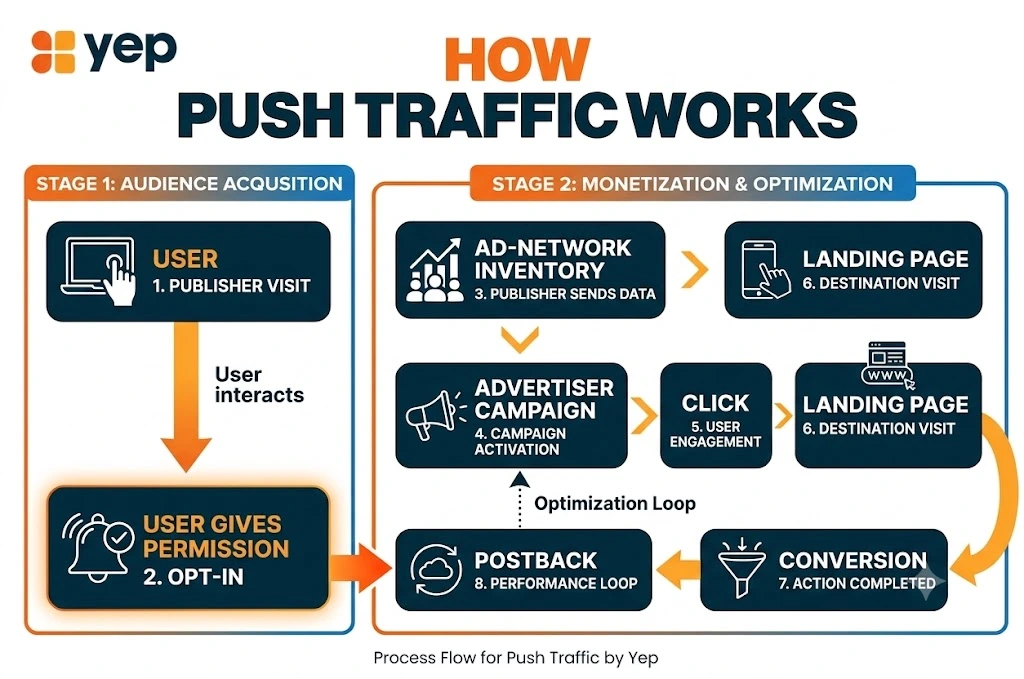
Image Source: Yep Ads
Main Features of Push Ads
Push may not be the newest format anymore, but it has stood the test of time. It started with simple mobile push notifications (lock screen, in-app, or messenger) and expanded into browsers. They’re short, eye-catching, and take up very little space, which makes them hard to ignore without being too intrusive.
Now there are three types of push ads:
- Classic web push: a system-level browser notification sent to someone who explicitly subscribed.
- In-page push: an ad displayed inside a publisher’s webpage that resembles a notification. It does not require a push subscription.
- App push: a notification from an installed native app. This is a separate channel from purchased web push traffic. Learn more about in-app traffic.
Classic Push vs. In-Page Push vs. App Push
| Feature | Classic web push | In-page push | App push |
|---|---|---|---|
| User permission required | Yes | No | App-level permission |
| Where it appears | Browser or system notification area | Inside a publisher’s webpage | Device notification area |
| Can appear after leaving the website | Yes | No | Yes |
| Installed app required | No | No | Yes |
| Available through web ad networks | Commonly | Commonly | Separate inventory |
| Affected by Chrome Push API limits | Potentially | No | No |
| Best reporting practice | Separate campaign | Separate campaign | Separate channel |
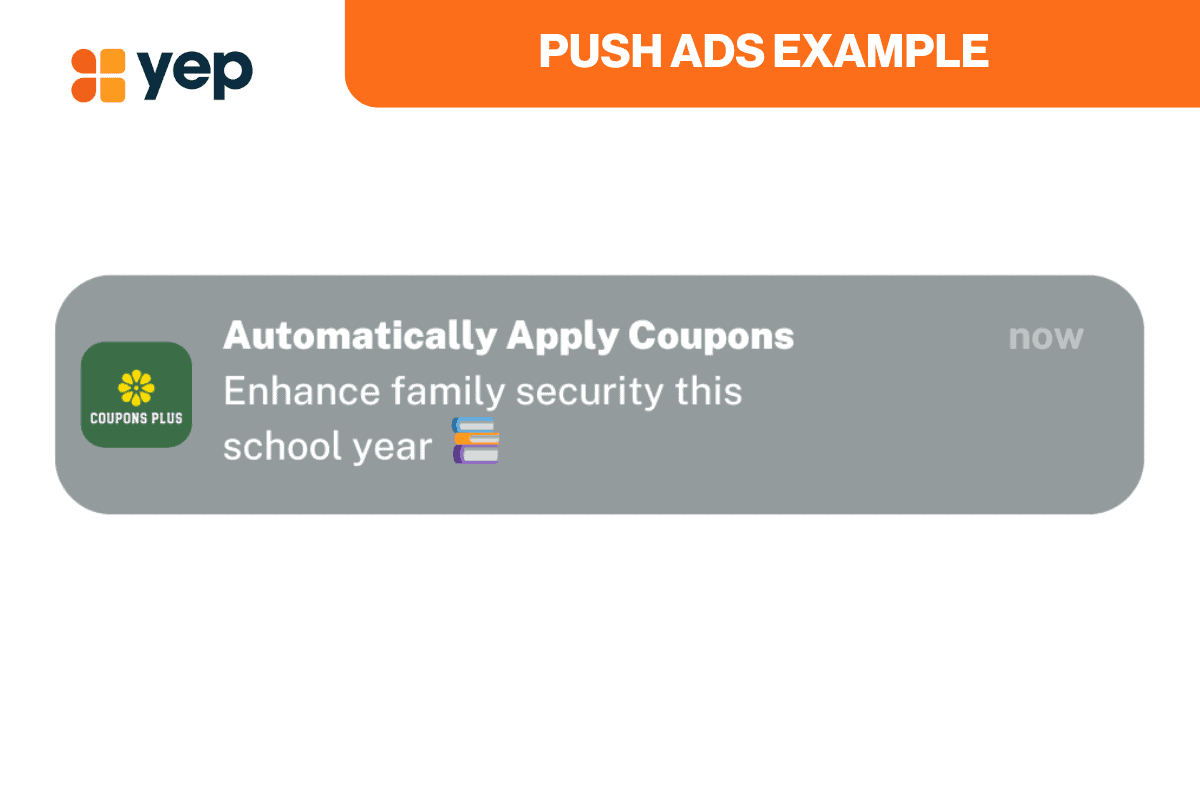
Image Source: Yep Ads
Strengths of Push Advertising
- Quick and simple opt-in process
- Notifications can include a headline, short text, image, and link. Some browsers allow rich push with larger visuals and action buttons, but notification appearance and supported functionality vary by operating system and browser. It’s a good idea to preview creatives by device because rendering can differ significantly.
- Works across both desktop and mobile, making retargeting easier. Push campaigns can reach desktop and mobile audiences, but availability depends on the format.
- Effective for user retention, a reminder often brings people back to your site or app.
- Highly adaptable: suitable for different verticals and audiences.
Note: Classic web push requires an explicit browser permission. The exact subscription flow varies by browser and device. On iOS and iPadOS, web push is available for supported Home Screen web apps. In-page push does not require notification permission because it is displayed inside the publisher’s webpage.
Limitations of Push Traffic
- Many desktop users block push notifications automatically.
- Limited space for messaging – headlines and creatives need to deliver impact fast.
Browsers increasingly suppress intrusive permission requests, revoke permissions for inactive or abusive sites and restrict excessive low-engagement push activity. This makes subscriber quality, relevance and frequency control increasingly important.
On January 6, 2026, Chrome announced that it was beginning to roll out Push API rate limits for sites that send many push messages despite receiving very little user engagement. Chrome says the measure is intended for a relatively small number of disruptive, high-volume sites – not ordinary websites sending relevant notifications.
Chrome says it initially calculates three factors daily:
- The number of push messages sent relative to the amount of time users spend on the site.
- The number of notification-permission prompts shown relative to time spent on the site.
- User engagement, including Chrome’s site-engagement score and foreground minutes.
When Chrome identifies disruptive behaviour, it can limit the site’s Push API requests, with excess requests returning an HTTP 429 response. Repeated disruptive behaviour can result in limits lasting several days.
This change applies to classic web push notifications that can be delivered while the website is closed. It does not apply to in-page push ads, native-app push or notifications generated while an open website is using the Notifications API. For affiliates, this makes it important to separate classic and in-page push reporting and to work with networks that monitor subscriber engagement, notification frequency and source quality.
How Much Does Push Traffic Cost?
Push traffic is commonly purchased on a cost-per-click basis, though pricing models vary by network and inventory. The actual price can vary by GEO, format, device, browser, source quality, vertical, competition and targeting options.
The lowest CPC does not necessarily produce the lowest acquisition cost. Affiliates should evaluate traffic based on conversions, approved leads and revenue rather than click price alone.
Break-even CPC = conversion rate × payout
If an offer pays $10 and converts 2% of clicks, the theoretical break-even CPC is:
0.02 × $10 = $0.20
This simplified calculation does not account for rejected leads, tracker costs, landing page costs, or other campaign expenses.
Best Affiliate Verticals for Push Traffic
Based on Yep Ads campaign data from January–June 2026, across selected GEOs push works particularly well for:
- Games, software, and utilities
- Subscription or deposit-based offers
- Sweepstakes, finance, and dating
Verticals like dating, sweepstakes, and e-commerce often convert more easily because actions are simple or low-cost. In contrast, gambling, apps, and higher-ticket products may need more persuasion due to deposits, multiple transactions, or higher prices.
It’s also important to note the difference between SOI (single opt-in) and DOI (double opt-in). DOI usually costs more but brings higher-quality leads, especially in demanding verticals with bigger payouts.
How Push Campaign Flows Work in 2026
The traditional funnel is straightforward: a user sees your notification, clicks, lands on your page, and completes an action. This flow is still widely used in 2026.
Push can also play a role in more layered strategies. For example, some affiliates send users from push to messengers or social channels, where warm-up content builds trust before the conversion. Others use push as a support channel for existing campaigns — attracting users with a banner, nurturing them with an advertorial, and later re-engaging them with push notifications.
Tips for Running Profitable Push Ad Campaigns
- Bid smart: don’t stick to the bare minimum. Low bids often bring low-quality traffic.
- Use advanced models: Smart CPC and automated bidding help optimize in real time.
- Test creatives: different images, headlines, and angles can dramatically change performance.
- Focus on clickability: a strong headline plus an engaging image is essential.
- Mind your timing: test to see when your audience responds best.
- Target fresh subscribers: they’re more likely to engage than older ones.
- Avoid oversaturation: too many notifications can drive users to unsubscribe.
Final Thoughts on Push Traffic in 2026
Push ads may look simple, but when combined with the right targeting and creative strategy, they remain a powerful tool in 2026. They can attract new users, retarget existing ones, and support your overall conversion flow. The key is balance: keep campaigns personal, well-timed, and optimized, and push will continue to deliver strong results.
You Might Also Like
- Traffic sources you might have overlooked
- New Social Traffic Sources For Affiliates in 2026
- Native ads for your advertising strategy
- What’s the Difference Between Native Ads vs. Display Ads
- Frequency Capping Explained: Stop Ad Fatigue
FAQs
What is push traffic in affiliate marketing?
Push traffic refers to users reached via push notifications on mobile or desktop devices. Affiliates use it to promote offers by delivering short, clickable ads directly to a subscriber’s device.
Which verticals perform best with push ads in 2026?
Dating, sweepstakes, utilities, e-commerce, finance, and betting are still among the top verticals for push ads.
Are push ads still effective in 2026?
Yes. Despite competition from newer formats, push ads remain cost-effective, scalable, and versatile when paired with the right targeting and creatives.
Share
