
Popunder Traffic: The Complete Guide for 2026
If you’ve spent any time buying or selling digital traffic, you’ve come across popunder ads. They’ve been around for over two decades, they’ve survived every browser update and privacy crackdown thrown at them, and they still move serious volume in 2026.
At Yep Ads, we’ve been in the performance marketing trenches since 2009. We work with affiliates running popunder campaigns daily, and we actively track how this traffic type evolves what converts, what doesn’t, and what’s changed so this guide is built on that hands-on experience.
Whether you’re an advertiser exploring new traffic sources, a publisher looking to monetize, or a media buyer expanding your channel mix, here’s everything you need to know about popunder traffic right now.
What Is Popunder Traffic?
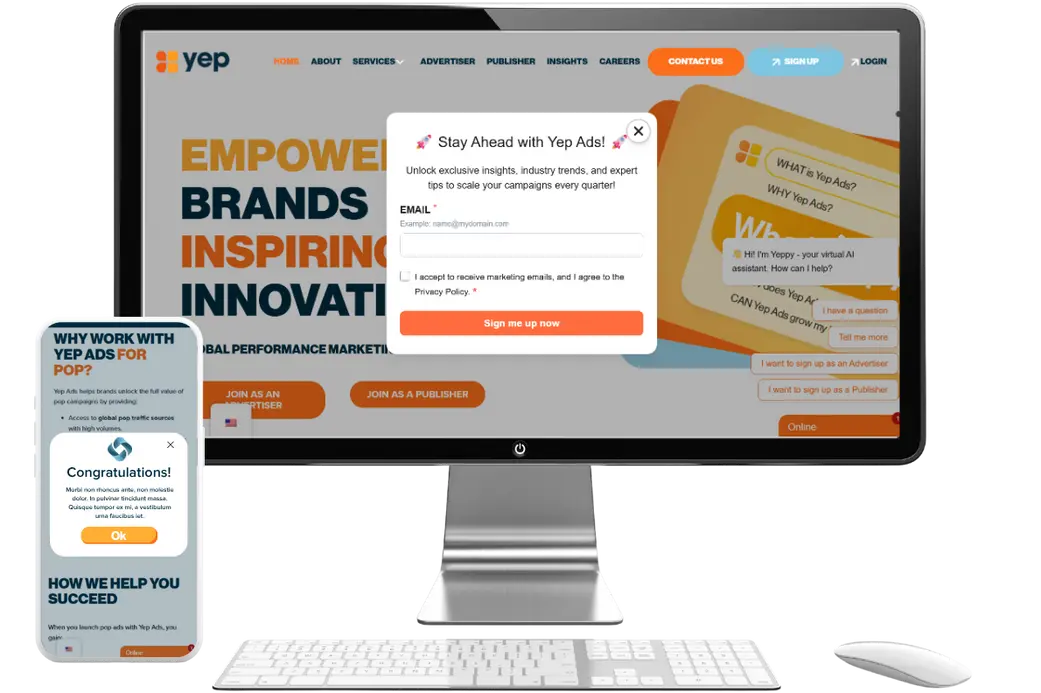
A popunder ad opens a new browser window behind the user’s active tab. Unlike a popup (which interrupts immediately), a popunder sits quietly in the background until the user closes or minimizes their main window and discovers it.
That distinction matters. Popups get blocked, closed, and resented. Popunders are usually seen when the user is between tasks, scrolling through their open tabs, or wrapping up a session. The result is a full-page ad impression delivered at a moment when the user is more receptive and less annoyed.
The format has been part of the digital advertising toolkit since the early 2000s. It’s outlasted flash ads, sidebar banners, and a dozen other formats because it does one thing well: it delivers high-volume, full-screen impressions at a fraction of the cost of display or native.
Quick distinction:
- Popup: Opens in front of the active window. Aggressive, high block rate, largely phased out.
- Popunder: Opens behind the active window. Less intrusive, better user experience, still widely used.
- Interstitial: Full-screen overlay ad within the same tab. Common on mobile. Different mechanic entirely.
How Popunder Ads Work
The technical flow is straightforward, but understanding it helps you buy and optimize smarter.
- A user visits a publisher’s website. The publisher has a popunder ad tag (a snippet of JavaScript) installed on their pages.
- The user takes an action, typically a click anywhere on the page. Modern popunder scripts are click-triggered to comply with browser policies. The days of auto-firing popunders on page load are long gone.
- A new browser window opens behind the active tab. The ad network’s server selects the highest-bidding advertiser whose targeting matches the user (GEO, device, OS, browser, etc.) and loads their landing page in the new window.
- The user discovers the ad later. When they close their current tab or cycle through windows, they see the advertiser’s page. At this point, they either engage or close it.
The key players in this chain:
- Advertisers set up campaigns on an ad network, define their targeting, set bids, and provide landing page URLs.
- Ad networks aggregate traffic from publishers, run the auction, handle targeting and frequency capping, and provide reporting dashboards.
- Publishers install the ad tag on their sites and earn revenue per impression (CPM) or per action.
Frequency capping is critical here. Every reputable network lets advertisers and publishers control how often a popunder fires for the same user, typically once per 24 hours per site. This prevents the bad old days of five popunders stacking up from a single visit.
Popunder Traffic in 2026: What’s Changed
If your last impression of popunder traffic was formed in 2018, it’s time to update. The landscape has shifted significantly.
Browser policies tightened. Chrome, Firefox, and Safari have all rolled out stricter popup and redirect blocking. This killed off low-quality scripts and networks that relied on deceptive triggering. What remains is cleaner click-initiated, user-action-based popunder delivery that plays by the rules.
Traffic quality improved as a direct result. When bad actors got filtered out, the average quality of popunder traffic went up. Networks invested in anti-fraud tech, bot detection, and traffic verification. That’s a real shift from five or six years ago.
Privacy regulations matured. GDPR, the ePrivacy Directive, and similar frameworks worldwide mean publishers and networks need proper consent flows. Compliant networks handle this; it’s one more reason to work with established players rather than obscure sources.
Pricing got more competitive. With fewer networks surviving the quality shakeout, the remaining ones offer more transparent pricing and better optimization tools. SmartCPM bidding, automated rules, and CPA goal optimization are now standard features, not premium add-ons.
From our side at Yep Ads, we’ve watched this evolution closely. The affiliates we work with who run popunder campaigns in 2026 are getting cleaner traffic, better conversion rates, and more predictable ROI than even three or four years ago. The format matured.
Who Uses Popunder Traffic and Why
Popunder isn’t a niche format; it’s used across a wide range of verticals and business models.
Advertisers
Popunder delivers what’s hard to get elsewhere: massive reach at a low CPM. A full-page landing page impression for a fraction of a cent is hard to beat if your funnel can handle the volume.
Common verticals where popunder traffic performs well:
- Gaming and entertainment game installs, streaming platforms, sweepstakes
- Finance insurance quotes, loan comparisons, trading platforms
- Software and utilities antivirus, VPN, cleaners, browser extensions
- Ecommerce flash sales, seasonal promotions, new product launches
- SaaS and apps free trial signups, mobile app installs
- iGaming sports betting, online casinos (GEO-dependent on regulations)
The common thread: these verticals have landing pages designed to convert cold traffic, offer something immediately compelling, and can absorb high volumes.
Publishers
For website owners, popunder is one of the simplest monetization methods. You add a script tag, and you earn revenue from the traffic you’re already getting. It works alongside display ads, native ads, or other monetization.
Publishers with high-traffic entertainment, streaming, file-sharing, news, or tool sites tend to see the best popunder CPMs.
Media Buyers and Agencies
Smart media buyers use popunder as part of a diversified traffic mix. It’s not a replacement for Meta or Google Ads it’s a complement. Popunder can drive top-of-funnel volume at scale, especially for offers that need wide geographic reach or massive impression counts on a budget.
How to Buy Popunder Traffic
Setting up a popunder campaign is simpler than most paid channels, but the details matter.
Step 1: Choose an add network
Pick a network with strong volume in your target GEOs, solid anti-fraud measures, and a reputation for traffic quality. We compare the top options in the next section.
Step 2: Set your targeting
Most networks let you target by:
- GEO (country, region, sometimes city)
- Device (desktop, mobile, tablet)
- Operating system (Windows, macOS, Android, iOS)
- Browser (Chrome, Firefox, Safari, Edge)
- Connection type (WiFi vs. carrier)
- Carrier (for mobile campaigns)
- Time of day / day of week
Start broader than you think, then narrow based on data. Over-targeting from the start limits the data you collect for optimization.
Step 3: Pick your bid model
- CPM (Cost Per Mille): You pay per 1,000 impressions. Standard, predictable, gives you full volume control.
- SmartCPM / Smart Bidding: The network auto-adjusts your bid to win auctions at the minimum necessary price. Saves budget, recommended for most campaigns.
- CPA Goal: You set your target cost per conversion, and the network’s algorithm optimizes delivery toward it. Requires conversion tracking and some initial data before it works well.
Step 4: Set up tracking
This is non-negotiable. Use a third-party tracker (Voluum, BeMob, RedTrack, Keitaro, or similar) with a postback URL configured so the network reports conversions back. Without this, you’re flying blind.
Step 5: Launch and monitor
Start with a moderate test budget. Let it run for at least 24-48 hours before making changes. Collect data on which GEOs, devices, OS versions, and time slots convert then cut what doesn’t work and scale what does.

How to Monetize with Popunder Ads (Publisher Side)
If you run a website and want to add popunder monetization, the setup is minimal.
How it works: You sign up with a popunder ad network as a publisher, get a JavaScript tag, and add it to your site. When users click on your page, a popunder fires and you earn revenue typically paid on a CPM basis.
What to expect for earnings: CPMs vary widely by GEO and niche. Your mileage depends on traffic volume, quality, and how well the ad networks’ campaigns match your audience.
Balancing monetization with user experience:
- Set frequency caps. One popunder per user per 24 hours is the standard. More than that and you’ll hurt your traffic.
- Monitor bounce rates and session duration. If popunder implementation tanks your engagement metrics, dial it back.
- Use it alongside other formats, not as your only revenue stream.
- Test placement some sites perform better with popunder on specific pages rather than site-wide.
Compliance matters. Make sure your consent management platform (CMP) covers the popunder tag, especially for EU traffic. Reputable networks handle most of this on their end, but it’s your site and your responsibility.
Top Popunder Ad Networks
Here’s a neutral look at the major networks operating in 2026. We’re not affiliated with any of them this is based on what we see working in practice across the campaigns our partners run.
| Network | Best For | Min. Deposit | Notable Features |
| PropellerAds | All-round, beginners and pros | $100 | CPA Goal bidding, massive volume, strong anti-fraud |
| RichAds | Performance-focused buyers | $150 | AI-powered optimization, granular targeting |
| HilltopAds | Both advertisers and publishers | $50 | Low entry point, direct publisher traffic |
| Adsterra | Wide GEO coverage | $100 | Self-serve and managed, Social Bar format option |
| ReachEffect | Scale campaigns | $100 | Premium traffic, advanced targeting |
| ClickAdilla | Adult and mainstream | $100 | Real-time bidding, fast approval |
| Galaksion | Smaller budgets, niche GEOs | $50 | Clean interface, decent support |
Tips for choosing:
- For testing: Start with a network that has a low minimum deposit and SmartCPM bidding.
- For scale: Choose one with deep volume in your target GEOs.
- For publishers: Look at their CPM rates for your traffic GEO and read reviews about payment reliability.
Optimization Best Practices
Launching a campaign is the easy part. Making it profitable is where the real work starts.
Frequency capping. Set it to one impression per user per 24 hours at minimum. Some media buyers go to one per 12 hours. More aggressive capping rarely improves things it just annoys people and burns through budget.
Use a prelander. Sending popunder traffic directly to a signup form or checkout page almost never works. A prelander (an intermediate page that warms up the user) consistently outperforms direct linking. Think of it as giving the user context before asking for the action.
Dayparting. Not all hours convert equally. Run your campaign 24/7 for the first few days, then cut the hours that underperform. For many verticals, evenings and weekends in the user’s local time outperform weekday working hours.
Segment and cut. After collecting initial data, break performance down by OS, browser, GEO, and carrier. You’ll almost always find that a few segments carry the campaign and the rest burn budget. Cut the losers aggressively.
Anti-fraud filtering. Enable whatever bot and fraud filtering your network offers. If your tracker supports it, set up additional IP/UA filtering. Bot traffic is the single biggest waste in popunder campaigns.
Landing page speed. Your landing page will load in a background tab. When the user finally sees it, it needs to be fully loaded and ready. A slow page means the user sees a blank or half-loaded screen and closes it immediately. Aim for under two seconds.
Test multiple landing pages. Rotate at least two or three variations. Even small changes to headlines, images, or CTAs can meaningfully shift conversion rates.
Common Mistakes to Avoid
We’ve seen these patterns hundreds of times across the campaigns that come through our network. Save yourself the trouble.
Starting with too many GEOs at once. It’s tempting to target 20 countries from day one. Don’t. Pick three to five, learn what works, then expand. Spreading a test budget too thin means you don’t get enough data in any single GEO to make smart decisions.
Ignoring traffic quality signals. If your CTR and engagement metrics look suspiciously good but conversions are flat, you’ve probably got bot traffic. Check your tracker for patterns identical user agents, impossible session durations, clicks within milliseconds of impression.
Skipping the tracking setup. Running popunder without server-to-server postback tracking is like driving without a dashboard. You won’t know what’s working until your budget is gone. Set it up before you launch, not after.
Not using a prelander. We mentioned this above, but it bears repeating. Cold traffic landing on a hard-sell page bounces. A well-built prelander can double or triple your conversion rate.
Overbidding early. Start with the network’s suggested bid or slightly below. You can always increase. Starting high and overpaying for untested traffic is the fastest way to blow through a test budget with nothing to show for it.
Neglecting compliance. Ad networks can and do ban accounts for non-compliant landing pages. Make sure your pages meet the network’s policies and applicable advertising regulations for your target GEOs. This is especially important in finance, health, and gambling verticals.
Is Popunder Traffic Right for You?
It’s a strong fit if:
- You have a high-converting landing page and want to scale volume fast
- Your CPA targets allow for high-volume, lower-intent traffic
- You’re in a vertical that works well with cold traffic (software, gaming, finance, sweepstakes, ecommerce)
- You want a cost-effective complement to your existing paid channels
- You’re a publisher with decent traffic volume looking for an easy monetization layer
It’s probably not the right fit if:
- Your campaign requires brand-safe, premium placements with full creative control
- You’re targeting highly specific demographics or interests that need platform-level targeting (like Meta or LinkedIn)
- Your product requires a long consideration cycle with multiple touchpoints before conversion
- You have very low traffic as a publisher (the earnings won’t justify the UX trade-off)
Work With Yep Ads
We’ve been in performance marketing since 2009, and popunder traffic has been part of our world from day one. We don’t just talk about this stuff we actively monitor campaign performance, track network quality, and refine what works across the verticals we operate in.
For affiliates: If you’re running popunder campaigns and looking for high-converting offers, reliable tracking, and a team that actually understands this traffic type, we want to hear from you. We work with affiliates who know what they’re doing and we back them with the support to scale.
For advertisers: If you’re interested in reaching audiences through popunder traffic on a performance basis, we can help. We structure partnerships around results you pay for outcomes, not promises. Whether you’re testing popunder for the first time or looking to expand an existing program, let’s talk.
Get in touch at yepads.com we’re always up for a conversation about what’s actually working right now.
You Might Also Like
- Media Buying Explained: Where to Buy Ads in 2026
- What Are Interstitial Ads? The 2026 Guide for Affiliates & Media Buyers
- What’s the Difference Between Native vs Display Ads
- How to Optimize Your Affiliate Marketing Campaign the Smart Way
Share